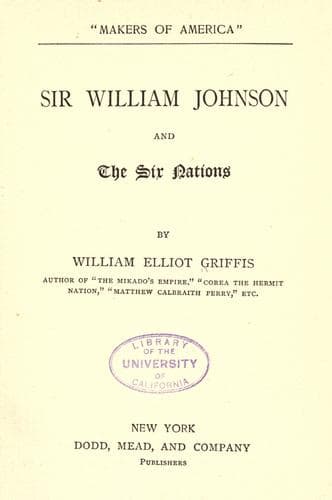
Sir William Johnson and the Six NationsGriffis, William Elliot
History
Sir William Johnson and the Six Nations
Griffis, William Elliot
Johnson, William, 1715-1774; United States -- History -- French and Indian War, 1754-1763
We see that the household at the Hall and in the quarters was almost as
cosmopolitan as New York itself. Simms tells us that Johnson’s
bouw-master, or head farmer, was an Irishman named Flood. He looked
after the ten or fifteen negro slaves who lived with their families in
cabins on the other side of the Cayudutta Creek, opposite the Hall. They
dressed much like Indians, but wore coats. His private secretary, after
Wraxall, Croghan, and others, was a Mr. Lafferty,—a good lawyer withal,
who attended also to Johnson’s legal business. The family physician,
named Daly, was a companionable and cultivated gentleman. Billy, a dwarf
about thirty years of age, was a master of the violin, and the presiding
genius of the numerous balls given in the Hall when “persons of quality”
were guests, or at the village when the tenantry or other citizens had
their merry-makings. The gardener kept the grounds “as neat as a pin,”
and from May to November smiling with flowers. The butler, Frank, was an
active young German; and the chief body-guard was Pontiac, a sprightly,
well-disposed lad of part Indian blood. He was named after the great
conspirator, and was often with Johnson when away from home. Two of the
waiters,—probably brothers,—named Bartholomew, were short, thick-set
white men. Across the road from the Hall were the blacksmith and the
tailor, who did little work outside of the “royal” or “patroon’s”
household. The numerous progeny and employees of Johnson furnished them
with almost constant occupation. One of the most important characters
was the schoolmaster, Wall, an Irishman with a rich brogue. His
specialty was the teaching of manners and rudiments of English to the
children of the tenantry and Johnson’s half-breed bastards. It may be
well imagined that the training given by Wall was rather to fit his
pupils for proper subordination than to be self-reliant patriots. In
front of the schoolhouse stood the whipping-post and the stocks, for
which truant boys, drunken louts, wife-beaters, and other transgressors,
actual and potential, were supposed to have due respect.
Holidays and out-door merry-makings were frequent. The many-sided lord
of the manor seemed most in his natural element when providing or
participating in the athletic sports, Irish games and frolics with which
he amused Indians and whites, old and young. Himself ever jovial and
fond of fun, he entered into the performances with an enthusiasm that
was magnetic. The greasy pole with a coin or other prize on the top was
set up for the nude Indian children to attempt to climb. The pig with
its tail likewise anointed was set free to be caught by him or her who
could. Tradition tells how, in one case, an old Indian squaw beat every
one in the race, and finally, having caught up a handful of sand, had
literally the grit to hold on and win the race. Sack, hurdle, and
three-legged races were also favourite amusements.
Public-domain text, read in full here on John Shaqi.
Reviews
Reviews
No reviews yet
Be the first to share your thoughts on this work.
Elsewhere in the archive
Join the Discussion
Join the discussion
Sign in to leave a comment or review.
Sign InorCreate an account