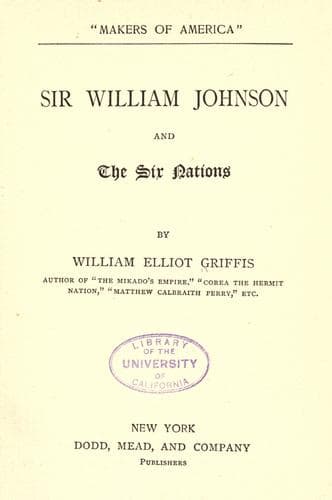
Sir William Johnson and the Six NationsGriffis, William Elliot
History
Sir William Johnson and the Six Nations
Griffis, William Elliot
Johnson, William, 1715-1774; United States -- History -- French and Indian War, 1754-1763
Besides all this out-door activity and healthy occupation, there was
plenty of amusement indoors. The numerous guests who came from all
quarters and at all times made Johnson Hall more like a grand hotel than
the private house of a gentleman. From April, after the ice in the
Mohawk had burst, as it often did, with a sound like cannon, and floated
out to the Hudson and to the sea, and the spring floods were over, until
the autumnal splendours of crimson and gold filled the Valley, the house
rarely lacked guests. Indian chiefs and warriors came at all times; but
in summer the paint and feathers of forest fashions were replaced by
those from beyond sea. The rouge, powder, patches, wigs, perukes, silken
gowns and stockings, silver-buckled shoes, and ruffled cuffs and
shirt-fronts from London, or patterned after Piccadilly prints, filled
the Hall with brilliant colour. With musical instruments, a well-filled
library, and the last new novel on the drawing-room table, the guests
could easily amuse themselves on a rainy day; while in fair weather
saunterings over the grounds of their host, or drives or rides in the
beautiful country around, made the daylight hours fly pleasantly. Then,
in full dress for the evening dinner, the night soon passed in feasting,
drinking, and exchanging news, with chat, gossip, and smoke; and more
than one of the hours of morning arrived before the concourse broke up.
Such a course of life was kept up for years, until the hospitality of
Johnson Hall became a proverb, and its revelry, we must add, passed into
a byword. Despite his constant out-door life and otherwise good habits,
it is more than probable that such luxurious living long persisted in
explains why the baronet never saw his sixtieth year.
In practical farming and in horticulture Johnson took great delight, and
in his intervals of leisure did much, both by personal example and by
neighbourly conference with the farmers, to improve crops and
live-stock. He was a regular correspondent of the Society for the
Promotion of Arts in England, and of the American Philosophical Society
in Philadelphia. Agriculture was one of the themes most often discussed
in his letters. He sent frequently to London for choice varieties of
seeds, and delighted to see how they fared in our climate and soil. Of
horses and other fine stock he was very fond, and to him is due the
credit of the introduction of sheep and blooded stallions. He also
credits himself with first raising hay, and thus stimulating the
development of improved breeds of cattle. While thus on his table lay
the last reviews and best periodical literature of London; while in his
library the European scholars, professors from Harvard and Yale, and
English ladies from London drawing-rooms, would all find books to their
taste, the pursuit of science indoors and out was carried on with ardour
by the lord of the manor himself.
Public-domain text, read in full here on John Shaqi.
Reviews
Reviews
No reviews yet
Be the first to share your thoughts on this work.
Elsewhere in the archive
Join the Discussion
Join the discussion
Sign in to leave a comment or review.
Sign InorCreate an account