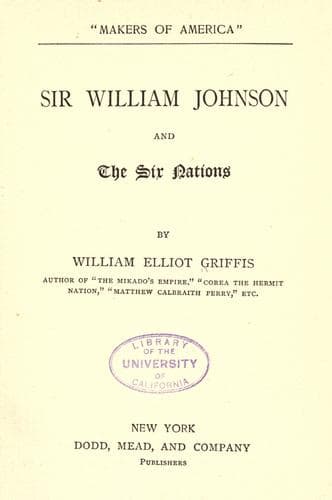
Sir William Johnson and the Six NationsGriffis, William Elliot
History
Sir William Johnson and the Six Nations
Griffis, William Elliot
Johnson, William, 1715-1774; United States -- History -- French and Indian War, 1754-1763
In attendance upon the county fair at Fonda during the summer of 1890,
the writer was struck with the variety and excellence of the live-stock,
as well as with the richness of the agricultural products of Montgomery
County. This county, with Saratoga and others adjoining, has had marked
influence upon the development of the region westward. Not a few of the
fine specimens of horses and cattle are descendants of the denizens of
the Johnson farm of pre-Revolutionary days. Certainly Johnson was one of
the benefactors of the race, who made many blades of grass grow where
none grew before. Not the least of his good offices was in prevailing
upon the British Government to relax the illiberal laws which prevented
the agricultural development of the Mohawk Valley. Much of England’s
troubles with her colonies arose from her determination to keep the
American part of her domain as a close market for exclusively British
products, and thus to compel the Americans to buy only those goods which
were manufactured in England or came from British ports. In thus
attempting to nip in the bud all flowering of the native genius of the
people, she succeeded in hampering, but not wholly repressing, American
manufactures. Johnson, as we have seen, was able to get removed the
restriction against raising wool. Peter Hasenclever, a Palatine German,
who owned land next to Johnson’s royal patent, started an iron foundry,
and though himself failing after long and earnest efforts, unable to
surmount the numberless difficulties, gave a great stimulus to the
development of the iron industry in Northern and Eastern New York.
Philip Schuyler set up a flourishing flax-mill.
Johnson lived to see the fearful results of the determination of the
lucre-loving British lords to force their products upon Americans at all
hazards. He regretted these violations not only of human rights in
general, but of Englishmen’s rights in particular; though not so
outspoken as he might have been. The Americans, while willing to be
customers to the greatest nation of shopkeepers, were resolved not to be
considered as buyers, and victims of monopoly only. Johnson fortunately
died before the covetousness, avarice, and arbitrary thick-headedness of
Great Britain, which had forced the slave-trade, hampered commerce, and
paralyzed foreign commerce and home manufactures, compelled the
colonists to rebuke her pretensions by an appeal to arms.
CHAPTER XIII.
JOHNSON’S FAMILY; LAST DAYS; EUTHANASIA.
Public-domain text, read in full here on John Shaqi.
Reviews
Reviews
No reviews yet
Be the first to share your thoughts on this work.
Elsewhere in the archive
Join the Discussion
Join the discussion
Sign in to leave a comment or review.
Sign InorCreate an account