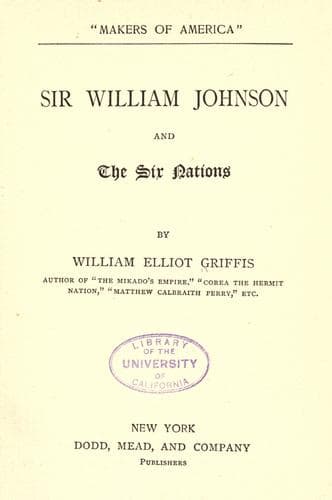
Sir William Johnson and the Six NationsGriffis, William Elliot
History
Sir William Johnson and the Six Nations
Griffis, William Elliot
Johnson, William, 1715-1774; United States -- History -- French and Indian War, 1754-1763
WHILE the brown Lady Johnson, Mollie Brant, presided over the mansion,
and her dusky brood attended the manor school, the daughters of Johnson
and of Catharine Wisenberg were trained under the care of a governess
who made them familiar with the social graces of London and the polite
accomplishments and standard literature of England. Mary Brant, though
not only an Indian, but a Mohawk Indian in spirit, was to her dying day,
in the old English and Hebrew sense of the word, a virtuous woman. She
had the virile qualities of worth, excellence, and abilities, and not
only managed her household to the satisfaction of her lord, but kept
herself well informed and interested in the two worlds in which lived
the people of the Long House and those of Christendom. More than one
English lady visiting at the Hall was surprised to find this Iroquois
woman so cultivated, refined, and alert, not only with womanly
intuition, but equipped with information as to the life and thoughts in
which they and their husbands moved.
Johnson was happy in the careers of his children born in wedlock, so far
as he lived to witness them. His first-born child, John, was the
especial pride of his father, though he never won the regard of his
neighbours. He had the misfortune to be the son of a great man, and to
be constantly compared with his father. He was educated under Domine
Vrooman and other clergymen of the Dutch Reformed and Anglican Churches.
He often accompanied his father on his journeys, notably the adventurous
one to Detroit in 1761. Later he was placed in command of three hundred
Iroquois; but these unfortunately deserted their commander, who had not
the power, like his father, to sweeten the rigours of discipline by
magnetic personality and system. He had considerable experience in the
field with the militia, but never won much personal popularity. Visiting
England to complete his education, he was presented at court, and
knighted at St. James’s, Nov. 22, 1765. He later became a member of the
Assembly, being pitted against Colonel Schuyler, who rightly or
wrongly—more probably the latter—imagined the father to be prodding
the son or using him for a cat’s-paw.
Public-domain text, read in full here on John Shaqi.
Reviews
Reviews
No reviews yet
Be the first to share your thoughts on this work.
Elsewhere in the archive
Join the Discussion
Join the discussion
Sign in to leave a comment or review.
Sign InorCreate an account