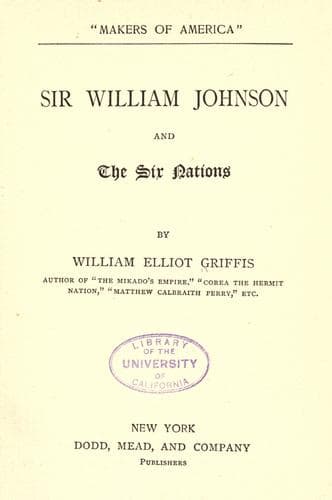
Sir William Johnson and the Six NationsGriffis, William Elliot
History
Sir William Johnson and the Six Nations
Griffis, William Elliot
Johnson, William, 1715-1774; United States -- History -- French and Indian War, 1754-1763
On the 29th of June, 1773, Sir John was married to Miss Mary Watts, of
New York City, the wedding being at the bride’s house. The bridal tour
was a trip up the Hudson River when Nature was dressed in her glorious
summer robes. A stay at Albany marked by brilliant social attentions,
and the ride up the loveliest of valleys, completed the journey. Johnson
Hall was then embosomed in a wealth of foliage and flowers, and bright
with the pageantry which manor life could on special occasions display.
Sir John, on the death of his father, succeeded to an estate which, with
the exception of that of the founder of Pennsylvania, was probably the
largest ever held by a private individual in America. At the request of
the Indians to Johnson, and of the latter to the king, Col. Guy Johnson
was made Superintendent of Indian Affairs, assisted by Colonel Claus;
but Sir John succeeded to the office of major-general of the militia. To
tell the story of his Tory career in the Revolution is no part of our
plan. “The Life and Misfortunes and Military Career of Brig.-Gen. Sir
John Johnson, Baronet,” has been ably written by Gen. J. Watts De
Peyster. In this book a list of Sir William Johnson’s descendants are
given.
Johnson usually called Anne, his first daughter, Nancy, and often wrote
to her while away from home. A son of one of the Palatine Germans,
Daniel Claus, a noted Indian fighter, captain of militia, and a man of
considerable culture in German, English, and the Iroquois languages, and
withal a favourite of Sir William, fell in love with Miss Nancy, and
married her in July, 1762. The nuptials were celebrated at Johnson Hall
with great rejoicing. Claus assisted his father-in-law and Joseph Brant
in translating and preparing the Book of Common Prayer in the Mohawk
language. In thus following up and completing the work of Domine
Barnhardus Freeman, of Schenectady, a manual of devotion was prepared
for the Mohawks which was in use until near the second half of the
present century. As colonel of militia, Claus saw long and varied
service in New York, Canada, and the West.
Mary Johnson, the baronet’s second daughter, married in March, 1763, her
cousin Guy, a nephew of Sir William and his private secretary. Guy
Johnson was later an active member of the Assembly from Tryon County,
and was always a helpful assistant of his uncle. Their daughter Mary
became wife of Sir Colin Campbell, and mother of Gen. Sir Guy Campbell.
Guy Johnson’s career in devastating the valleys of New York during the
Revolution is too well known to need repetition here.
Public-domain text, read in full here on John Shaqi.
Reviews
Reviews
No reviews yet
Be the first to share your thoughts on this work.
Elsewhere in the archive
Join the Discussion
Join the discussion
Sign in to leave a comment or review.
Sign InorCreate an account