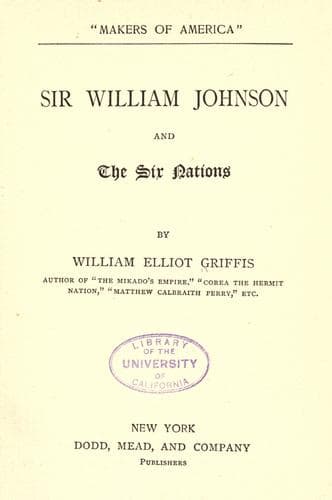
Sir William Johnson and the Six NationsGriffis, William Elliot
History
Sir William Johnson and the Six Nations
Griffis, William Elliot
Johnson, William, 1715-1774; United States -- History -- French and Indian War, 1754-1763
The absorption of Johnson’s mind in his multifarious labours and in the
interests of the community in which he lived, scarcely gave him time to
study carefully the great political movements leading to the Revolution.
The time had now come when the continued folly of the king and
Parliament acting as irritant and stimulant upon people in whom a love
of freedom was inborn, was to result in independence. The long training
in the border wars had educated a generation of soldiers who did not
fear to meet either the mercenaries or the regulars of Great Britain,
while also well able to profit by the mistakes of the king’s agents, and
to organize government for themselves. On the civil side, the people of
New England, led and trained by Congregational clergymen rather than by
lawyers, were educated into the idea of resistance to the king and
Parliament on grounds of abstract right. In the Middle and Southern
States regularly educated publicists and lawyers trained in England were
much more numerous. The continued invasion by the king of their rights
as Englishmen was their theme; and resistance was made, and final
victory expected, not by revolution, but through the right application
of the law and tradition which had been so often violated. In many of
the colonies a well-grounded fear lest a politically organized church
should be forced upon them, as well as hatred of England’s avaricious
policy of holding the colonies as a close market, had also their
influence in bringing about separation.
Johnson, too busily occupied to follow every step of the movements, yet
sympathized with the people, even while sincerely loyal to the Crown. As
member of the Council in New York City, he witnessed not only the
frequent turbulent expressions of the populace, but also saw from the
firm temper of the Assembly signs of the coming danger. While John
Dickinson, of Pennsylvania, and Samuel Adams, of Massachusetts, were
discussing the political situation and the principles at stake, the
people of New York showed by their acts their constant determination to
resist all invasion of their rights by either the king or his agent. The
governor, Sir Henry Moore, who dissolved the Assembly in 1769, found out
quickly that the members were re-elected by overwhelming majorities. His
sudden death called to the office of acting governor, for the third
time, Dr. Cadwallader Colden.
Public-domain text, read in full here on John Shaqi.
Reviews
Reviews
No reviews yet
Be the first to share your thoughts on this work.
Elsewhere in the archive
Join the Discussion
Join the discussion
Sign in to leave a comment or review.
Sign InorCreate an account