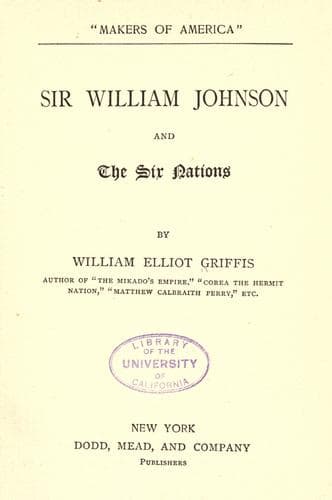
Sir William Johnson and the Six NationsGriffis, William Elliot
History
Sir William Johnson and the Six Nations
Griffis, William Elliot
Johnson, William, 1715-1774; United States -- History -- French and Indian War, 1754-1763
In the following March the political sky, already full of the portents
of a coming storm, gathered a deeper blackness when the fact became
known that the House of Commons in London had refused to receive the
representative of the New York Assembly. In spite of prophetic warnings
and wise cautions in Parliament, the determination to make merchandise
of the colonies stupefied and debauched the conscience of the average
lord and commoner of commercial England, as the opium question in China
stupefies and debauches it yet. The government was as much determined on
a war with the American colonies, and for much the same purpose, as so
many of Great Britain’s later wars have been waged,—for the sake of
maintaining trade. Of the twenty-five or thirty wars, even during
Victoria’s reign, the majority have been for the purpose of forcing
trade and making money. In a word, the war of King George and his
Parliament in 1775 against the colonies was a shopkeeper’s war for a
market. “British interests” then, as now, meant trade and profits.
Johnson felt the injustice of the British Government’s acts when he
wrote in 1769: “Whatever reason or justice there may be in the late
steps, there is a probability of their being carried farther than a good
man can wish.” Nevertheless, Sir William was wisely non-committal on the
burning question.
The Sons of Liberty in New York became active and turbulent, and made
the lives of ultra-loyalists, like Colden, a burden. The royal troops
had been by his orders summoned to New York City, after he had been
driven to take refuge in the fort on the outbreak of violence when the
stamps arrived from England. These soldiers were now the targets of
scorn, especially after the Assembly had refused indemnity to Colden,
who kept on recommending them to supplicate the paternal tenderness of
their gracious sovereign George. After concurring in the spirited
resolutions of the Legislatures of Virginia and South Carolina, the
Assembly had also defeated a cunning scheme to win from them a vote of
money to support the king’s military forces.
The hatred between the soldiers and the Sons of Liberty burst into flame
at the battle of Golden Hill, Jan. 18, 1770, in New York City, when the
first blood of the American Revolution was spilled. The Sons of Liberty
had erected an emblem of their freedom and hereditary rights. The
liberty-pole, and their meetings with speeches under it, were survivals
of the old custom of their Teutonic ancestors, who met in the folk moot
under the chosen oak-trees in the forests of Germany before Christendom
began. The liberty-pole with its spars was obnoxious to the redcoats,
who with saw and gunpowder tried to destroy it. The citizens resisted,
but the unarmed and unorganized mob broke before the charge of armed men
with bayonets. Having finally succeeded in sawing the pole into
kindling-wood, the military piled the fragments before the doors of the
tavern where the Sons of Liberty met.
Public-domain text, read in full here on John Shaqi.
Reviews
Reviews
No reviews yet
Be the first to share your thoughts on this work.
Elsewhere in the archive
Join the Discussion
Join the discussion
Sign in to leave a comment or review.
Sign InorCreate an account