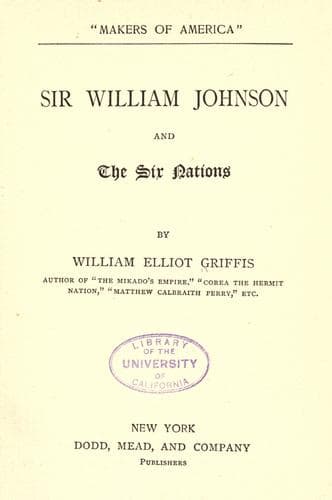
Sir William Johnson and the Six NationsGriffis, William Elliot
History
Sir William Johnson and the Six Nations
Griffis, William Elliot
Johnson, William, 1715-1774; United States -- History -- French and Indian War, 1754-1763
In Schenectady, Johnson would find that many of the men were away in the
Indian country, with their canoes and currency of strouds, duffels, and
trinkets, trading for furs. He would soon learn that many could speak
the Indian tongue, some of the younger men and girls being excellent
interpreters; while he would notice that wampum-making, or “seewant,”
for money, made by drilling and filing shells, was a regular and
legitimate industry. Possibly the young churchman may have stayed over a
Sunday, and in the large stone edifice, capable of seating over six
hundred persons, heard, if he did not understand, the learned Domine
Reinhart Erichzon preach. After the liturgy and psalms, read by the
clerk or fore-reader, the domine, in gown and bands, ascended the
wineglass-shaped pulpit to deliver his discourse.
In any event, whether Johnson’s stay was long or short in the Dorp, we
should see him making exit through the north gate, and either going
landward along the Mohawk, which is hardly possible, or, as is more
probable, loading his goods and outfit on one of the numerous canoes
always ready, and rowing or being rowed up the river. The twenty-four
miles or so of distance could be easily covered, despite the rifts and
possible portages, in a single day. Evening would find him, either in
camp on the new estate or hospitably lodged in some log-house of the
Dutch or German settlers. He was now in the heart of what the Dutch have
been wont to call the Woestina, or wilderness, but which was now too
much settled to be any longer so spoken of,—the term beginning to be
then, as it is now, restricted to a locality near Schenectady.
Warren’s Bush, or Warren’s Burg, was the name of the farm which the
young Irishman was to cultivate. Warrensburg was the written name, but
almost any new settlement was usually spoken of as “bush.” It lay on the
south side of the Mohawk, some distance east of the point where the
creek, fed by the western slopes of the Catskills, empties into the
river, and was named Schoharie, from the great mass of driftwood borne
down. No more fertile valleys than these, watered by the rain or melted
snows of the Catskills and Adirondacks, exist. Besides the river-flats
that were kept perennially fertile by nearly annual overflows and a top
dressing of rich silt, the old maize-lands of the Mohawk were vast in
extent, and all ready for the plough. The region west of Albany was then
spoken of by the colonists as “the Mohawk country,” from the chief tribe
of the Iroquois who inhabited it. Let us glance at the human environment
of the new settler.
Public-domain text, read in full here on John Shaqi.
Reviews
Reviews
No reviews yet
Be the first to share your thoughts on this work.
Join the Discussion
Join the discussion
Sign in to leave a comment or review.
Sign InorCreate an account