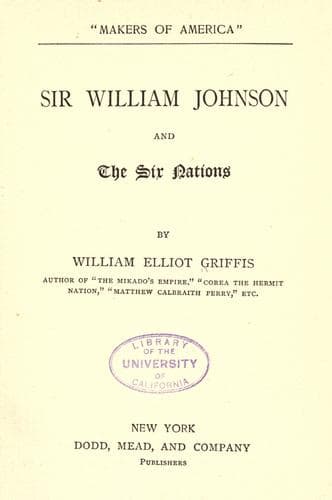
Sir William Johnson and the Six NationsGriffis, William Elliot
History
Sir William Johnson and the Six Nations
Griffis, William Elliot
Johnson, William, 1715-1774; United States -- History -- French and Indian War, 1754-1763
In the house of the tapster, or innkeeper, he would probably stay all
night. He would find the Street of the Martyrs (so named after the
massacre of 1690), and of the Traders, together with Front, Ferry,
Church, and Niskayuna Streets, lined with comfortable, one-storied,
many-gabled dwellings, with here and there neat houses, all or partly of
brick. Each house stood with its cosey bivalve door, shut at the bottom
to keep out pigs and chickens and to keep in the babes, and open at the
top to admit light and air. The scrupulously neat floors spoke of the
hereditary Dutch virtue of cleanliness. On the table could be seen a
wealth of plain but wholesome food, such as few farmer-folk in the old
countries of Europe could boast of. The bill of fare would include the
well-cured hams for which “the Dorp” was famous, all kinds of savoury
products of the hog, besides every sort of bread, pie, cake, and plain
pastry, baked to a shining brown in the ample ovens of stone or brick,
which swelled like domes outside of the houses, at the rear of the
kitchens. Savoury and toothsome were the rich “crullers” which Captain
Croll, the good church-elder and garrison-commander of Rensselaerwyck,
had invented during a winter-season of meat-famine. On many a house
veered iron weathercocks, especially on the few brick fronts monogrammed
with dates in anchors of iron; while on the new church, only four years
old, but the third in the history of the growing town, glittered the
cock of Saint Nicholas in gilt. It rested over a belfry which held a
most melodious bell, cast at Amsterdam, in dear old “Patria,” in the rim
of which, as well-founded tradition insisted, many a silver guilder,
spoon, and trinket had been melted. Perhaps Johnson, like many a
European and even New England militiaman, did not understand why the
Dutch built their stone fortress-like churches at the intersection of
two streets. Some even hinted at stupidity; but the Dutchmen, for the
same reason that they loop-holed the walls, so located their chief
public buildings at the centre of the village as to be able to sweep the
cross streets with their gun-fire in case of an attack by French or
Indians, or both.
Public-domain text, read in full here on John Shaqi.
Reviews
Reviews
No reviews yet
Be the first to share your thoughts on this work.
Join the Discussion
Join the discussion
Sign in to leave a comment or review.
Sign InorCreate an account