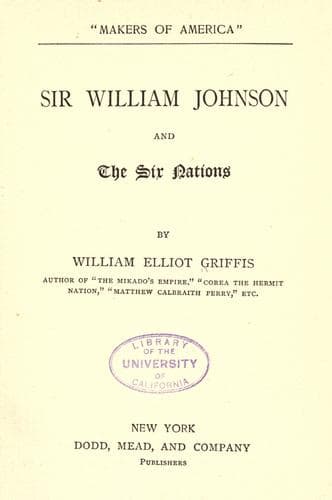
Sir William Johnson and the Six Nations — John Shaqi
Sir William Johnson and the Six NationsGriffis, William Elliot
History
Sir William Johnson and the Six Nations
Griffis, William Elliot
Johnson, William, 1715-1774; United States -- History -- French and Indian War, 1754-1763
This line of settlements formed the frontier or line of outposts of
civilization. On every side their frontagers were the Iroquois, or
Indians of Five Nations, while right among them were the Mohawks. Only
one English outpost faced Lake Ontario. This was the trading-station of
Oswego. Here in 1722, the daring governor, William Burnet, aiming at the
monopoly of the fur-trade, in defiance of the French, and in the face of
the Seneca Indians’ protest, unfurled the British flag for the first
time in the region of the Great Lakes. He built the timber lodge at his
own expense, and encouraged bold young men, mostly from Albany and the
valley settlements, to penetrate to Niagara and beyond. These commercial
travellers—prototypes of the smart, well-dressed, and brainy drummers
of to-day, and in no whit their inferiors in courage, address, and
fertility of resource—went among the western Indians. They learned
their language, and so opened the new routes of trade that within a
twelvemonth from the unfurling of the British flag at Oswego there were
seen at Albany the far-off lake tribes and even the Sioux of Dakota.
Trade received such a tremendous stimulus that in 1727 Governor Burnet
erected a regular fort at Oswego, where, in 1757, a French traveller
found sixty or seventy cabins in which fur-traders lived. A promising
settlement, begun by the Palatine Germans at Herkimer, was called
Burnet’s Field, or, on the later powder-horn maps, Fort Harkiman.
The fur-trade in our day calls for the slaughter annually of two hundred
million land quadrupeds; drives men to ravage land and ocean, and even
to rob the water animals of their skins; sends forty million peltries
annually to London alone, and is still one of the great commercial
activities of the world. It was relatively much greater in Johnson’s
day; and to gain a master’s hand in it was already his ambition. It was
the year 1738, the date of the birth of George III. of England, whom
later he was to serve as his sovereign. Arriving in the nick of time,
Johnson began at once the triple activities of settling his uncle’s
acres with farmers, of opening a country store, and of clearing new land
for himself. This latter was rapidly accomplished, Indian fashion, by
girdling the trunks one year, thus quickly turning them into leafless
timber, and planting either corn or potatoes the next season, in the now
sunlighted and warm ground. Or the standing timber was cut down and by
fire converted into potash, two tons to the acre, which was easily
leached out, and was quickly salable in Europe.
Corn or maize was the crop which above all others enabled the makers of
America to hold their own and live; and corn was the grain most
plentifully raised in the Mohawk Valley, though wheat was an early and
steady crop. Corn meal is still sold in England as “Oswego flour,”—a
name possibly invented by Johnson, who became a large exporter of grain
and meal.
Public-domain text, read in full here on John Shaqi.
Reviews
Reviews
No reviews yet
Be the first to share your thoughts on this work.
Join the Discussion
Join the discussion
Sign in to leave a comment or review.
Sign InorCreate an account