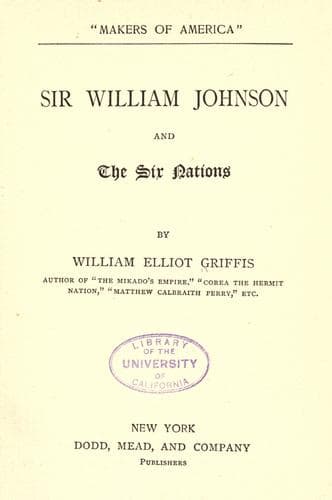
Sir William Johnson and the Six NationsGriffis, William Elliot
History
Sir William Johnson and the Six Nations
Griffis, William Elliot
Johnson, William, 1715-1774; United States -- History -- French and Indian War, 1754-1763
To be landlord’s agent, pioneer settler, farmer, and storekeeper all in
one, Johnson needed assistance in various ways and resolved to have it.
He had from the first come to stay for life and grow up with the
country. He was probably in America less than a year before he took as
his companion, Catharine, the daughter of a German Palatine settler
named Weissenburg, or Wisenberg.[3] Kate was the only wife Johnson ever
had, and the only woman with whom he lived in wedlock. She is described
as a sweet-tempered maiden, robust in health, fairly dowered with mental
abilities, and with a good influence over her husband. No record of the
marriage ceremony has yet been found; but the couple, if not joined in
wedlock by some one of the Dutch or German clergymen of the Valley, as
is most likely, had their wedding before the Rev. Thomas Barclay, an
English Episcopal missionary. Mr. Barclay laboured at Fort Hunter, and
in the little English church officiated for years, as well as at Albany
and Schenectady; but the records of Fort Hunter have not survived the
accidents of time. When in 1862 the dust of this maker of America was
disturbed, and his bones sealed up in granite for more honourable
burial, a plain gold ring was found, inscribed on the inside, “June.
1739. 16.” This date may have been that of his marriage with “Lady”
Johnson, his own lawful wife, who probably needed no title to adorn the
beautiful character which tradition bestows upon her. Johnson, when a
baronet with laurelled brow, and a fame established on two continents;
the head of a family in which were two baronetcies, father and son,—an
honour unparalleled in American colonial history,—made a will,
preserved in Albany, in which he desired the remains of his “beloved
wife Catharine” interred beside him. Of Molly Brant, his later mistress,
he spoke and wrote as his housekeeper; of the Palatine German lawfully
wedded to him, as his beloved wife.
Doubtless, also, for the first years of married life, through her
exemption from family cares, though these weighed lightly in early
colonial days, in the absence of the artificial life of the cities, she
was enabled to attend to the store, while her husband worked in the
field, rode with grist to the mill, or traded with the Indians in their
villages. Their first child, John, was not born until they had crossed
the Mohawk River, and occupied Mount Johnson, in 1742.
Public-domain text, read in full here on John Shaqi.
Reviews
Reviews
No reviews yet
Be the first to share your thoughts on this work.
Join the Discussion
Join the discussion
Sign in to leave a comment or review.
Sign InorCreate an account