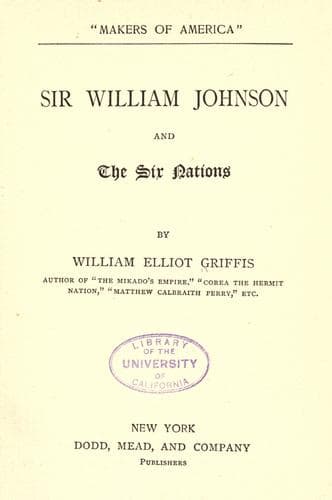
Sir William Johnson and the Six Nations — John Shaqi
Sir William Johnson and the Six NationsGriffis, William Elliot
History
Sir William Johnson and the Six Nations
Griffis, William Elliot
Johnson, William, 1715-1774; United States -- History -- French and Indian War, 1754-1763
As early as May 10, 1739, we find this man of restless activity planning
to locate a branch trading-house on the Susquehanna, two hundred miles
to the south. Already he had seen the advantages and prospect of speedy
wealth in the fur-trade, a privilege won years before by his Schenectady
neighbours. He now entered diligently into it, employing a number of
runners or bos-lopers, who scoured the woods and valleys populated with
Indians, in his interest, diverting the trade from Albany to his own
post. This was the beginning of jealous quarrels between him and the
Albanians. That his eye was keenly open to every new advantage or
possibility of progress, was seen in his buying as early as 1739, after
one year’s residence in the valley, a lot of land across the Mohawk, on
which ran a stream of water, the Chucktununda Creek, with abundance of
potential mill-power. To ride horseback with bags fifteen miles to
Caughnawaga every time meal was needed, was too much loss of time and
energy. The German women had long carried bags of wheat and maize from
Schoharie to Schenectady, traversing the distance on foot, bearing corn
in coming and grist in returning, on their backs. There was a mill at
Caughnawaga, and one owned by the Dutch Church at Schenectady, both
sufficiently distant. Johnson saw at once in a mill ease and revenue.
The Indian name of the stream, Chucktununda, is said to mean “stone
roofs or houses,” and was applied to other watercourses with banks of
overhanging rocks which formed shelter during rain. This coveted spot
became later the famous “Mount” Johnson, on which the stone
fortress-mansion still stands, at Akin, three miles west of Amsterdam
and visible to all railway travellers as they fly between the great Lake
City and New York.
The appearance of the Mohawk Valley, though still unchanged in its great
cosmic features of sky, mountain, and main watercourses, was vastly
different a century and a half ago. On its surface were many minor
features quite different from those which to-day greet the eye of
traveller, denizen, or palace-car inmate. Then the primeval forest, rich
in game, covered hill and dale, except along the river-flats, where were
great expanses of meadow in the wide level of the valley. Here were
maize-fields surrounding the Indian villages for miles.
Public-domain text, read in full here on John Shaqi.
Reviews
Reviews
No reviews yet
Be the first to share your thoughts on this work.
Join the Discussion
Join the discussion
Sign in to leave a comment or review.
Sign InorCreate an account