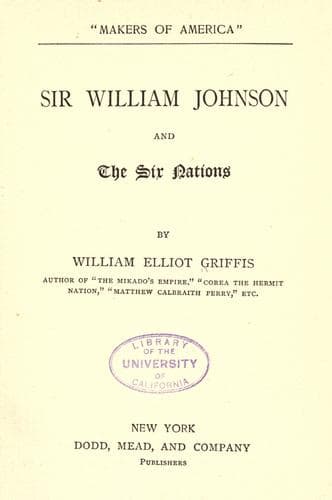
Sir William Johnson and the Six NationsGriffis, William Elliot
History
Sir William Johnson and the Six Nations
Griffis, William Elliot
Johnson, William, 1715-1774; United States -- History -- French and Indian War, 1754-1763
Owing, however, to the largeness of forest area, the streams were of
greater proportions and much more numerous than at present. Fish were
vastly abundant, and so tame as to be easily caught, even with the hand
of Indian or white skilled in wood and water craft. Animal life was rich
and varied to a degree not now easily imaginable or even credible, did
not the records of geology, of contemporary chronicles, and the voices
of tradition all agree on this point. Then the “wild cow” or bison,
though rapidly diminishing, owing to the introduction of fire-arms, was
still a source of fur and food. Besides the elk, deer were plentiful on
the hills, often seen drinking at night and early in the morning at the
river’s brink, and occasionally were killed inside of the new
settlements. A splendid specimen of elk horns from a buck shot by
Johnson on his own grounds, was presented by him to Chief Justice Thomas
Jones, who wrote a loyalist history of New York during the Revolutionary
War, and long adorned the hall of Fort Neck mansion on Long Island.
Smaller fur-bearing animals were beyond the power of arithmetic. Wolves
were uncomfortably numerous, active, and noisy. To their ceaseless
nocturnal music there were slight pauses of silence, except when some
gory battle-field or scalping-party’s raid or unusual spoil of hunters
became the storm-centre, and gathered them together from a radius of
many miles. Most notable of all the animals, in physical geography, in
commerce, and for clothing, was the beaver. This amphibious creature of
architectural instincts was the great modifier of the earth’s surface,
damming up tens of thousands of the hill streams which fed the great
rivers, and thus causing a vast surface of the land, otherwise dry, to
be covered with water, while it greatly changed the appearance of the
landscape. There are to-day thousands of grassy and mossy dells which
even the inexperienced eye sees were once the homes of the beavers,
while thousands of others have long since, under the open sun, become
fertile meadows. The beaver, by yielding the most valuable of the furs,
furnished also the standard of value in trade. The beaver as seen on the
seal of the city of York, like the prehistoric _pecus_, or cattle, which
made _pecu_niary value, or the salt of the ancient _sal_ary or rice in
old Japan, was quoted oftener than coin.
Public-domain text, read in full here on John Shaqi.
Reviews
Reviews
No reviews yet
Be the first to share your thoughts on this work.
Join the Discussion
Join the discussion
Sign in to leave a comment or review.
Sign InorCreate an account