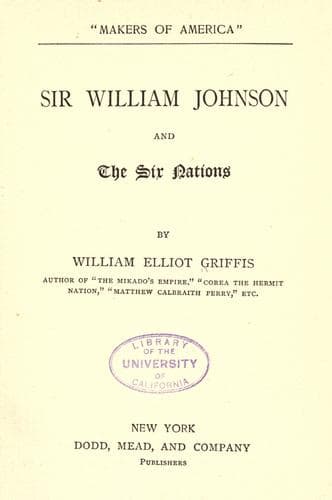
Sir William Johnson and the Six Nations — John Shaqi
Sir William Johnson and the Six NationsGriffis, William Elliot
History
Sir William Johnson and the Six Nations
Griffis, William Elliot
Johnson, William, 1715-1774; United States -- History -- French and Indian War, 1754-1763
In 1639, at the foundation of Rensselaerwyck, trade was nominally thrown
open to all. What was formerly done covertly by interlopers and servants
of the company, became the privileges of every burgher. Though still
rigidly denied to outsiders, traders’ shops soon sprung up along the
muddy streets of the colony, and an immense business was done over the
greasy counters. The gallon kegs of brandy, called ankers; a puncheon of
beer; a pile of shaggy woollen stuffs, then called duffles, and now
represented most nearly by Ulster or overcoat cloth; a still coarser
fabric called strouds, for breech clouts and squaws’ clothes, with axes
and beads, formed the staple of the cheaper order of shopkeepers. In the
better class of dealers in “Indian haberdashery,” and in peltries,
potash, and ginseng, the storehouses would have an immense array of all
sorts of clothes, hats and shoes, guns, knives, axes, powder, lead,
glass beads, bar and hoop iron for arrow-heads, and files to make them,
red lead, molasses, sugar, oil, pottery, pans, kettles, hollow ware,
pipes, and knick-knacks of all sorts. It was not long before the desire
to forestall the markets entered the hearts of the Dutch as well as the
French; and soon, matching the _courier du bois_, or hardy rangers of
the Canadian forests, emerged the corresponding figure of the
bos-lopers, or commercial drummers. This prototype of the present natty
and wide-awake metropolitan, in finest clothes, hat, and gloves, with
most engaging manners and invincible tongue, was a hardy athlete in his
prime, able to move swiftly and to be ever alert. He was well versed in
the human nature of his customers. Skilled in woodcraft, he knew the
trails, the position of the Indian villages, the state of the tides,
currents, the news of war and peace, could read the weather signs, the
probabilities of the hair and skin crops, the fluctuations of the
market, and was usually ready to advance himself by fair advantage, or
otherwise, over his white employer or Indian producer. Rarely was he an
outlaw, though usually impatient of restraint, and when in the towns,
apt to patronize too liberally the liquor-seller.
Public-domain text, read in full here on John Shaqi.
Reviews
Reviews
No reviews yet
Be the first to share your thoughts on this work.
Join the Discussion
Join the discussion
Sign in to leave a comment or review.
Sign InorCreate an account