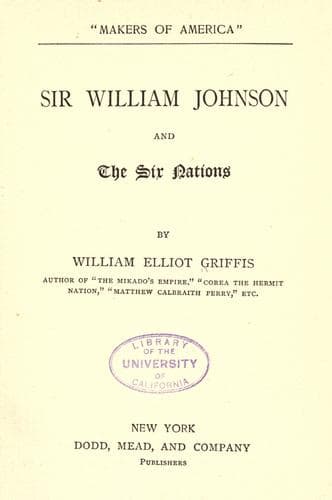
Sir William Johnson and the Six Nations — John Shaqi
Sir William Johnson and the Six NationsGriffis, William Elliot
History
Sir William Johnson and the Six Nations
Griffis, William Elliot
Johnson, William, 1715-1774; United States -- History -- French and Indian War, 1754-1763
The Indian trails of New York were first obliterated by wagon-roads or
metaled turnpikes, and then covered by iron rails and wooden ties. The
flanged iron wheels have taken the place of the moccasin, as loco-motor
and freight-carrier; but in Johnson’s time the valleys, passes, and
portages or “carries” were all definitely marked, and generally easily
visible, on account of the long tramping of inturned feet. There are
places to-day on the flinty rock polished by long attrition of
deer-leather soles; and wherever the natural features of the landscape
point to the probable saving of linear space, there skilled search
usually reveals the old trail. One of the first proofs of the genius of
Johnson and the entrance in his mind of continental ideas was his
thorough study of the natural highways, trails, and watercourses of the
Iroquois empire, and the times and methods of their punctual migrations.
He soon found that while late autumn, winter, and spring was their
season for trapping and shooting their game, June, July, and August
formed the period when the peltries were brought in for sale. In early
autumn they went fishing, or their travelling-parties were on peaceful
errands, such as attending those council-fires which filled all the
atmosphere with blue haze. As a rule, the Indians avoided the mountains,
and dwelt in the valleys and well-watered regions, where fish and game
for food, osiers and wood fibres for their baskets, clay for their rude
pottery abounded, and where pebbles of every degree of hardness were at
hand, to be split, clipped, drilled, grooved, or polished for their
implements of war, ceremony, and religion. In savage life, vast areas of
the earth’s surface are necessary for his hunting and nomad habits.
Agriculture and civilization, which mean the tilling and dressing of the
earth, enable a tribe to make a few acres of fertile soil suffice, where
one lone hunter could scarcely exist. The constant trenching upon the
land of the wild hunter and fisherman, by the farmer and manufacturer,
who utilize the forces of Nature, and the resistance of the savage to
this process, make the story of the “Indian question.”
Apart from the pretext of religion, equally common to all, the main
object of French, Dutch, and English traders was fur, as that of the New
England coast men was fish. The tremendous demand of Europe and China
kept the prices of peltries high, and it was in this line of commercial
effort that fortunes were most quickly made, most of the early profits
being reckoned at twenty times the amount of outlay. Until 1630 a strict
monopoly of two trading-companies shut out all interlopers from the
Indian country.
Public-domain text, read in full here on John Shaqi.
Reviews
Reviews
No reviews yet
Be the first to share your thoughts on this work.
Join the Discussion
Join the discussion
Sign in to leave a comment or review.
Sign InorCreate an account