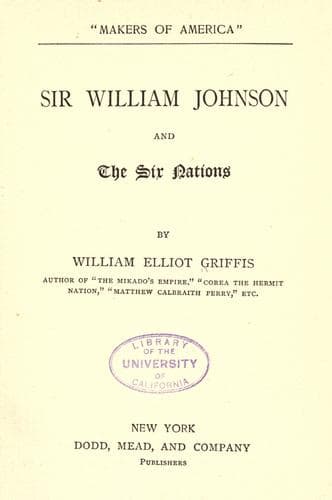
Sir William Johnson and the Six NationsGriffis, William Elliot
History
Sir William Johnson and the Six Nations
Griffis, William Elliot
Johnson, William, 1715-1774; United States -- History -- French and Indian War, 1754-1763
Despite his many cares, Johnson enjoyed reading and the study of
science. He ordered books and periodical literature regularly from
London. His scientific taste was especially strong in astronomy. To the
glorious canopy of stars, which on winter nights make the
mountain-walled valley a roofed palace of celestial wonders, Johnson’s
eyes were directed whenever fair weather made their splendours visible.
In autumn the brilliant tints of the sumach, dogwood, swamp-maple,
sassafras, red and white oak, and the various trees of the order of
_Sapindaceæ_ filled the hills and lowlands with a glory never seen in
Europe. His botanical tastes could be enjoyably cultivated, for in
orchids, ferns, flowering plants, and wonders of the vegetable world,
few parts of North America are richer than the Mohawk Valley.
-----
[2] The young and charming Lord James Radcliffe, Earl of Derwentwater,
the idol of the Jacobites, was beheaded 24th of February, 1716; that is,
on the very day, it is claimed by Col. T. Bailey Myers, that Sir William
Johnson was born, and the wild fervour of a Jacobite loyalty was still
alive when Sir John was a boy.—DE PEYSTER’S _Life of Gen. John
Johnson_, Introd., p. xvi.
[3] Mr. E. F. De Lancey, the well-known writer on American history and
genealogy, knew personally the grandchildren of Sir William Johnson, and
has embodied valuable information about him and them in his notes to
Jones’s “History of New York during the Revolutionary War.” In his
letter to the writer, dated March 28, 1891, he kindly sent a transcript
from a letter in Mrs. Bowes’s own handwriting—“Information my father
gave me when with him. Catharine Wisenberg, a native of Germany, married
to Sir W. Johnson, Bart. in the U. States of America, died in 1759.”
Mrs. Bowes was a daughter of Sir John Johnson, who was a son of Sir
William Johnson. It is probable that the spelling Wisenberg is only the
phonetic form of Weissenburg. The local gossip and groundless
traditions, like those set down by J. R. Simms, are in all probability
worthless.
CHAPTER III.
THE SIX NATIONS AND THE LONG HOUSE.
THE military nerves of the continent of North America lie in the
water-ways bounding, traversing, or issuing from the State of New York.
Its heart is the region between the Hudson and the Niagara. In these
days of steam-traction, when transit is made at right angles to the
rivers, and thus directly across the great natural channels of
transportation, New York may be less the Empire State than in the days
of canoes and bateaux. Yet even now its strategic importance is at once
apparent. In the old days of conflict, first between the forces of Latin
and Teutonic civilization, and later between British king-craft and
American democracy, it was the ground chosen for struggle and decision.
Public-domain text, read in full here on John Shaqi.
Reviews
Reviews
No reviews yet
Be the first to share your thoughts on this work.
Join the Discussion
Join the discussion
Sign in to leave a comment or review.
Sign InorCreate an account