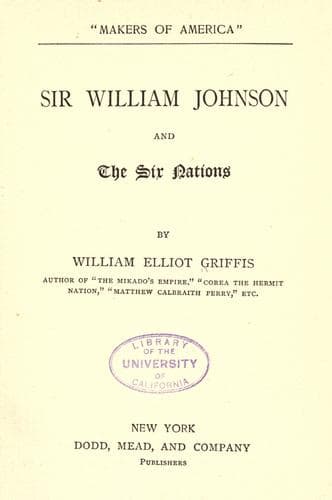
Sir William Johnson and the Six Nations — John Shaqi
Sir William Johnson and the Six NationsGriffis, William Elliot
History
Sir William Johnson and the Six Nations
Griffis, William Elliot
Johnson, William, 1715-1774; United States -- History -- French and Indian War, 1754-1763
Before the European set foot on the American continent, the leading body
of native savages had discovered the main features of this great natural
fortress and place of eminent domain. Inventors of the birch-bark canoe,
the red man saw that from this centre all waters of the inland ocean
made by the great lakes, the warm gulf, and the salt sea, could be
easily reached. With short land-portages, during which the canoe, which
served as shelter and roof at night and house and vehicle by day, could
be carried on the shoulders, the Indian could paddle his way to Dakota,
to Newfoundland, or to Hudson’s Bay on the north, or the Chesapeake and
the Mississippi and the Gulf of Mexico on the south. In his moccasins he
could travel as far. From New York State the pedestrian can go into
twenty States and into two thirds of the territory of the United States
without leaving the courses of valleys. No other State can so
communicate between the east and the west without overcoming one or more
mountain ridges. The T-shaped Hudson-Mohawk groove in the earth’s crust
unites the valleys east of Massachusetts. With such geographical
advantages, added to native abilities, the Iroquois were able to make
themselves the virtual masters of the continent of North America.
Here, accordingly, was built the Long House; that is, was organized the
federation of the Five Nations. Like the Pharaohs, Sultans, Mikados, and
European princes of the world which we call old, because of its long
written history, these forest sovereigns named their government after
their house. The common edifice of the Iroquois was a bark structure
fifty or more feet long, and from twelve to twenty feet wide, with doors
at either end. In each dwelling lived several families.
So also, in the Great Long House, stretching from the Hudson to the
Niagara, dwelt at first five families. The Mohawks occupied the room at
the eastern end of the house, in the throat of the Mohawk Valley, the
_schenectady_, or “place just outside the door,” being on the
“mountain-dividing” or Hudson River. More exactly, the place of “Ye
treaties of Schenectady” was at the mouth of Norman’s Kill, a little
south of Albany. Here was the place of many ancestral graves, where
multitudes of the dead lay, and where Hiawatha, their great civilizer,
dwelt.
Public-domain text, read in full here on John Shaqi.
Reviews
Reviews
No reviews yet
Be the first to share your thoughts on this work.
Join the Discussion
Join the discussion
Sign in to leave a comment or review.
Sign InorCreate an account