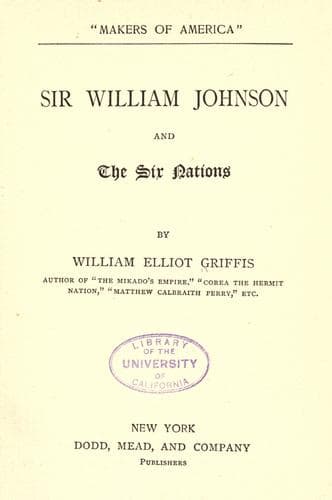
Sir William Johnson and the Six NationsGriffis, William Elliot
History
Sir William Johnson and the Six Nations
Griffis, William Elliot
Johnson, William, 1715-1774; United States -- History -- French and Indian War, 1754-1763
This much seems certain, that at the opening of the seventeenth century
the whole continent was a dark and bloody ground, in which war was the
rule and peace the exception; in which man hunted man as the beasts and
fishes destroy and devour one another. The Iroquois, speaking
substantially one language, were as an island in a great Algonkin ocean.
Unlike mere fishermen and hunters they were agriculturists, and many
hundred square miles were planted with their maize, squashes, pumpkins,
beans, tobacco, and other vegetables, edible or useful. They were able
to store up corn for long campaigns and to brave a season of famine. The
streams furnished them with fish, and they hunted the deer, elk, bison,
and smaller animals for flesh or furs; but their noblest game was man.
To kill, to scalp, to save alive for torture, to burn his villages and
houses, to wreak vengeance on his enemies, was rapture to the savage.
Before they knew gunpowder, the Iroquois, equipped with flint weapons
and clothed in bark armour, often fought in the open field and with
comparative personal exposure. Their battles were by masses of men who
were led by chiefs, and their tactics and strategy resembled those of
white men before the introduction of fire-arms. One famous field in the
open ground near Schenectady was long pointed out in Indian tradition as
the place where the great battle between the Iroquois and the Algonkins
had been fought before the coming of the whites. For the defence of
their villages they built palisades with galleries for the defenders to
stand on, and with appliances at hand to put out fires, or to repel
assaults and drive off besiegers. Theirs was the age of stone and wood;
but their civilization was based on agriculture, which made them
superior to that of their neighbours, whom they had compelled to be
tributary vassals.
The apparition of the white man and the flash of Champlain’s arquebus,
vomiting fire and dealing death by invisible balls, changed all Indian
warfare and civilization. Gunpowder wrought as profound a revolution in
the forests of America as in Europe. Bark or hide shields and armour
were discarded; bows and arrows were soon left to children; the line and
order of battle changed; fighting in masses ceased; the personal
influence of the chiefs decreased, and each warrior became his own
general. Individual valour and physical strength and bravery in battle
counted for much less, and the dwarf was now equal to the giant.
Public-domain text, read in full here on John Shaqi.
Reviews
Reviews
No reviews yet
Be the first to share your thoughts on this work.
Join the Discussion
Join the discussion
Sign in to leave a comment or review.
Sign InorCreate an account