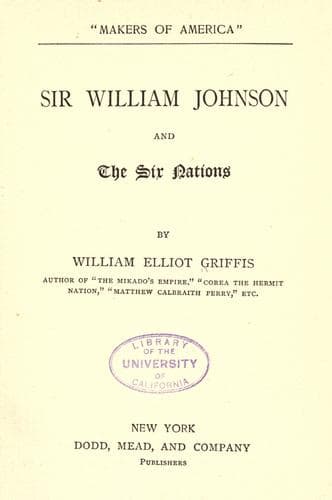
Sir William Johnson and the Six NationsGriffis, William Elliot
History
Sir William Johnson and the Six Nations
Griffis, William Elliot
Johnson, William, 1715-1774; United States -- History -- French and Indian War, 1754-1763
An equally great revolution in industry took place when the stone age
was suddenly brought to a close and the age of metals ushered in. The
iron pot and kettle, the steel knife, hoe, hatchet, and the various
appliances of daily life made more effective and durable, almost at once
destroyed the manufacture of stone and bone utensils. The old men lost
their occupation, and the young men ceased to be pupils. This loss of
skill and power was tremendous and far-reaching in its consequences; and
its very suddenness transformed independent savages into dependents upon
the white man. In time of famine or loss of trade, or interruption of
their relations with the traders caused by political complications, the
sufferings of the Indians were pitiable.
Champlain’s shot dictated the reconstruction of Indian warfare; but the
Iroquois took to heart so promptly the lesson, that the Algonkins north
of the St. Lawrence were able to profit little by their temporary
victory. Full of hate to the French for interfering to their
disadvantage, the Mohawks at once made friends with the Dutch.
Both Hudson and Champlain had visited Mount Desert Island, and thence
separating had penetrated the continent by the great water-ways, both
reaching the heart of New York within a few miles of each other. While
the French founded Quebec, and settled at Montreal, the Dutch made a
trading settlement on the Hudson at Norman’s Kill, Tawasentha. This
“place of many graves” and immemorial tradition was the seat of their
great civilizer and teacher, Hiawatha, who had introduced one phase of
progress. It was now destined to be the gateway to a new era of change
and development. As in Japan, at the other side of the globe, at nearly
the same time white men, gunpowder, and Christianity had come all
together.
It was not out of disinterested benevolence that the confederate savages
sought the friendship of the Hollanders. They came to buy powder and
ball, to arm themselves with equal weapons of vengeance, and to protect
themselves against the French.
But if Champlain was a mighty figure in the imagination of the red man
of the Mohawk Valley, there was coming a greater than he. This new man
was to impress more deeply the imagination of all the Iroquois, and his
name was to live in their language as long as their speech was heard on
the earth. Champlain was a bringer of war; “Corlaer” was an apostle of
peace.
Public-domain text, read in full here on John Shaqi.
Reviews
Reviews
No reviews yet
Be the first to share your thoughts on this work.
Join the Discussion
Join the discussion
Sign in to leave a comment or review.
Sign InorCreate an account