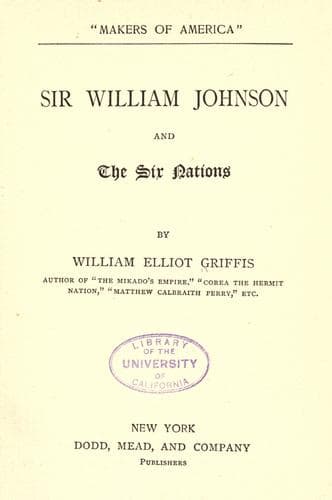
Sir William Johnson and the Six NationsGriffis, William Elliot
History
Sir William Johnson and the Six Nations
Griffis, William Elliot
Johnson, William, 1715-1774; United States -- History -- French and Indian War, 1754-1763
As first-cousin of Kilian Van Rensselaer, Arendt Van Curler, a native of
the country near Amsterdam, but probably of Huguenot descent, reached
America in 1630, and became superintendent and justice of the colony at
Rensselaerwyck. From the very first he dealt with the Indians in all
honour, truth, and justice. He was a man of sterling integrity, a Dutch
patriot, and a Christian of the Reformed faith, but also a man of
continental ideas, a lover of all good men, and a Catholic in the true
sense of the term. He rescued from death and torture the Christian
prisoners in Mohawk villages; and his first visit into, or “discovery”
of the Valley as far as Fonda in September, 1642, was to ransom Father
Jogues. His description of “the most beautiful land on the Mohawk River
that eye ever saw,” and the journal of his journey, probably sent with
his letter of June 16, 1643, to the Patroon, form the first written
description of the Valley. He mastered the vernacular of the savages,
visited them at their council-fires, heard their complaints, dealt
honestly with them, and compelled others to do the same. The first
covenant of friendship, made in 1617, between the Dutch and the
Iroquois, and its various later renewals, he developed into a policy of
lasting peace and amity. The scattered links of friendship between the
Dutch and the confederacy of Indians he forged into an irrefragable
chain, which, until the English-speaking white men went to war in 1775,
was never broken. In 1663 he saved the army of Courcelles from
starvation and probably destruction. Winning alike the respect of the
French in Canada, and of their enemies, the Mohawks, he was invited to
visit the governor, Tracy, in Quebec. On his journey thither in 1667, he
was drowned in Lake Champlain near Rock Regis, the boundary-mark between
the Iroquois and Algonkin Indians. This lake, like the Mohawk River, and
the town of Schenectady which he founded, the Indians and Canadians
called Corlaer.
Rarely, if ever, was a council held in Albany or at Johnson’s house or
at the Onondaga fireplace, that Corlaer’s name was not mentioned, and
their “covenant chain” with him referred to under the varied figures of
rhetoric.
Van Curler’s policy was continued and expanded by Peter Schuyler, a son
of Van Curler’s warm personal friend, Philip Schuyler. As the Iroquois
in speaking never closed the lips, but used the orotund with abundance
of gutturals, they were unable to pronounce properly names in which
labial consonants occurred. They could not say Peter; so they called
their friend “Quider.” The policy of Johnson was simply a continuation
and expansion of that of these two Hollanders, Van Curler and Schuyler.
There was no name of any white man that Johnson heard oftener in the
mouths of the Indians than that of Corlaer; and yet, in the index of
seventy thousand references to the Johnson manuscripts in Albany there
is no reference to this founder of the Dutch policy of peace with the
Indians.
Public-domain text, read in full here on John Shaqi.
Reviews
Reviews
No reviews yet
Be the first to share your thoughts on this work.
Join the Discussion
Join the discussion
Sign in to leave a comment or review.
Sign InorCreate an account