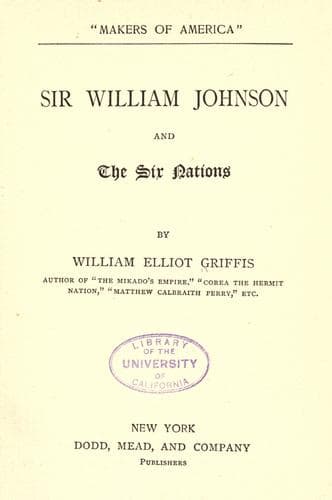
Sir William Johnson and the Six NationsGriffis, William Elliot
History
Sir William Johnson and the Six Nations
Griffis, William Elliot
Johnson, William, 1715-1774; United States -- History -- French and Indian War, 1754-1763
In their political and social procedures, in public discourse, and in
the etiquette of councils, no denizens of European courts were more
truly bond-slaves to etiquette and custom than these forest senators. In
certain outward phases of life—especially noticed by the man of hats,
boots, and clean underclothing—the Indian seems to be a child of
freedom, untutored and unsophisticated. In reality he is a slave
compared to the enlightened and civilized man. He is by heredity,
training, and environment fettered almost beyond hope. His mind can move
out of predestined grooves only after long education, when a new God,
new conceptions, induced power of abstract reasoning, and an entirely
new mental outlook are given him. First of all, the savage needs a right
idea of the Maker of the universe and of the laws by which the creation
is governed; and then only does his mental freedom begin. So far from
being free from prescribed form, he is less at liberty than a Chinese or
Hindu. His adherence to ceremonial runs into bigotry. The calumet must
be smoked. The opening speech must be on approved models. The wampum
belts are as indispensable in a treaty as are seals and signatures in a
Berlin conference or a Paris treaty. To challenge tradition, to step out
of routine, to think for himself, and to act according to conviction, is
more dangerous and costly to him than to one who has lived under the
codes of civilization.
To gain his almost invincible influence over these red republicans of
the woods, Johnson, like his previous exemplars, had to let patience
have her perfect work. He had to stoop to them in order to lift them up.
He even learned to outdo them in ostentation of etiquette, in rigid
adherence to form, in close attention to long speeches without
interruption, in convincing eloquence, in prolixity when it was
necessary to subdue the red man’s brain and flesh by the power of the
tongue, and in shine and glitter of outward display. Like a shrewd
strategist, this typical Irishman knew when to exercise his native gift
of garrulity in talking against time, and when also to condense into
fiery sentences the message of the hour.
Public-domain text, read in full here on John Shaqi.
Reviews
Reviews
No reviews yet
Be the first to share your thoughts on this work.
Join the Discussion
Join the discussion
Sign in to leave a comment or review.
Sign InorCreate an account