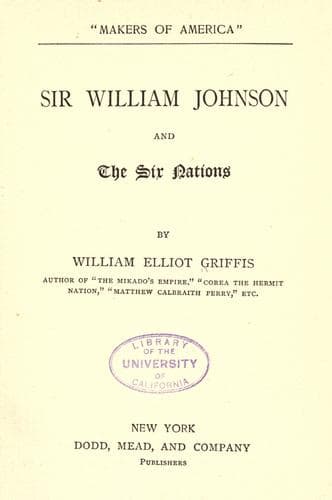
Sir William Johnson and the Six NationsGriffis, William Elliot
History
Sir William Johnson and the Six Nations
Griffis, William Elliot
Johnson, William, 1715-1774; United States -- History -- French and Indian War, 1754-1763
One chief reason, however, why the Iroquois preferred to talk with him
more than with the average colonial grandee, was because they were not
when before him at the mercy of interpreters. Despite the fact that time
was of little value to the savage, it was rather trying to an Indian
orator, after dilating for an hour or two in all the gorgeous eloquence
of figurative language, to the manifest acceptance of his own kinsmen at
least, to have an interpreter render the substance of his oration in a
few sentences. Unaccustomed to abstract reasoning, the Indian was
perforce obliged to draw the images of thought entirely from the
environment of his life on land and water. Hence his speech
superabounded with metaphors. He thoroughly enjoyed the discourse of one
of his pale-faced brothers whose flowery language, while insufferably
prolix to his fellow-whites, ran on in exuberant verbosity. In such a
case, as Johnson soon learned to know, the sons of the forest felt
complimented and flattered. Rarely was a speaker interrupted. Extreme
rigidity of decorum was the rule at their councils. On great and solemn
occasions the women were called as witnesses and listeners to hold in
their memory words spoken or promises given.
There were other resources of human intercourse besides words. The
wampum strings that reminded one of rosaries, or the belts made of
hundreds and thousands of black and white shells, served as telegrams,
letters missive, credentials, contracts, treaties, currency, and most of
the purposes in diplomacy and business. The principal chief of a tribe
had the custody of these archives of State. A definite value was placed
upon these drilled, polished, and strung disks or oval cylinders of
shell. The Dutch soon learned to make a better fabric than the Indian
original, and they taught the art to the other colonists. Weeden, in his
“Economic History of New England,” has shown how great an aid to
commerce this, the ancient money of nearly all nations, proved in the
early days when coined money was so scarce. The belts used as
newsletters, as tokens of peace or war, as records of the past, or as
confirmations of treaties, were often generous in width and length,
beautifully made, and fringed with coloured strings. Schenectady was a
famous place of wampum or seewant manufacture; and Hille Van Olinda, an
interpreter, received in 1692 two pounds eight shillings for two great
belts. Two others of like proportions cost three pounds twelve
shillings. A large quantity of this sort of currency was always carried
by the French to win over the Indians to their side. The same commercial
and diplomatic tactics were also followed by the English, and especially
by Johnson.
Public-domain text, read in full here on John Shaqi.
Reviews
Reviews
No reviews yet
Be the first to share your thoughts on this work.
Join the Discussion
Join the discussion
Sign in to leave a comment or review.
Sign InorCreate an account