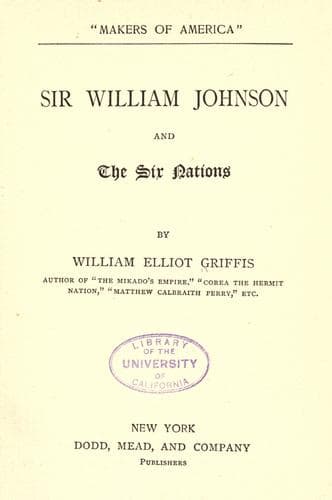
Sir William Johnson and the Six Nations — John Shaqi
Sir William Johnson and the Six NationsGriffis, William Elliot
History
Sir William Johnson and the Six Nations
Griffis, William Elliot
Johnson, William, 1715-1774; United States -- History -- French and Indian War, 1754-1763
While the white man’s gunpowder and bullets, war, diseases, fire-water,
and trade wrought profound changes for better or worse, usually the
latter, the Indians were not stolid or unreceptive to his religion. Both
the Roman and the Reformed teachers won many disciples in the Long
House. Almost as soon as the learned Domine Megapolensis arrived at Fort
Orange, he began to learn the language of the Mohawks. He was soon able
to preach to them and to teach their children. This was three years
before John Eliot began his work in Massachusetts. The pastors at
Schenectady did the same, translating portions of the Bible and of the
liturgy of the Netherlands Reformed Church, and of the Book of Common
Prayer. The missionary efforts of the Dutch Christians soon bore
definite and practical results. The Reformed Church records show large
numbers of Indians baptized or married or buried according to Christian
rites. There are also frequent instances of adult communicant membership
in the Mohawk, Hudson, Raritan, and Hackensack Valleys. Hundreds of
Indian children were trained in the same catechetical instruction, and
in the same classes with those of the whites. As a general rule, the
Hollanders and other peoples from the Continent lived in kindness and
peace with their red brethren. The occasional outbreaks of the savages
in massacre, fire, and blood were not by those of New York, but from
Canada. The Indians were set on like dogs by the French, who stimulated
the thirst for blood by political and religious hatreds; and the English
repaid in kind. Rarely was the peace broken between the people of New
Netherlands and New York except by causes operative in, and coming from
Europe.
The first Roman Catholic who entered the bounds of the State of New York
was Isaac Jogues, who was captured by the Mohawks while ascending the
St. Lawrence River. One of the sweetest spirits and noblest characters
that ever glorified the flesh he dwelt in, Isaac Jogues was brought
captive into the Mohawk Valley to be reserved for fiendish torture.
Ransomed by Arendt Van Curler, and assisted to France by Domine
Megapolensis, these three men of the Holy Catholic Church became ever
after true friends. The surface discords of church names were lost in
the deeper harmonies of their one faith and love to a common Saviour.
Bressani was later assisted in like manner. Returning willingly, by way
of Quebec, after his fingers, once chewed to shapeless lumps between the
teeth of the Mohawks, had been kissed by nobles and ladies in the court
at Versailles, Jogues reached, four years later (1647), the scene of his
martyrdom and nameless burial. His severed head, mounted upon one of the
palisades of the Indian castle, was set with its face to Canada, whence
he came, in insult and defiance.
Public-domain text, read in full here on John Shaqi.
Reviews
Reviews
No reviews yet
Be the first to share your thoughts on this work.
Join the Discussion
Join the discussion
Sign in to leave a comment or review.
Sign InorCreate an account