Sir William Johnson and the Six Nations — John Shaqi
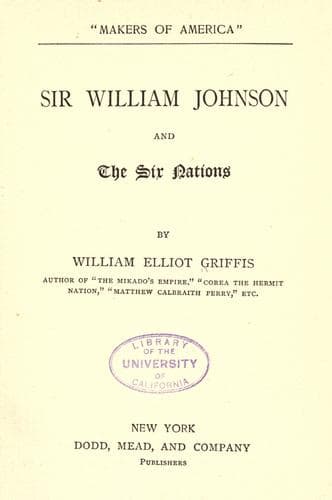
Sir William Johnson and the Six NationsGriffis, William Elliot
History
Sir William Johnson and the Six Nations
Griffis, William Elliot
Johnson, William, 1715-1774; United States -- History -- French and Indian War, 1754-1763
Nevertheless, the French Jesuit missionaries, with unquailing courage
and fervent faith, persevered; and Poncet, Le Moyne, Fremin, Bruyas, and
Pierron passed to and fro through Albany to continue the work in what
they had already named as the Mission of the Martyrs. In 1667 St. Mary’s
Chapel was established at the Indian village which stood on the site of
Spraker’s Basin. In 1669 St. Peter’s Chapel was built of logs on the
sand-flats at Caughnawaga near Fonda, by Boniface. Here in 1676 the
Iroquois maiden Tegawita—the White Lily of the Mohawks, the now
canonized saint—was baptized by James de Lamberville. From 1642 to 1684
was the golden age of early missions of the Roman form of the Christian
faith in New York. Then it was abruptly brought to a close, not because
of Indian animosity or Protestant opposition, but by the Roman Catholic
Governor Dongan in the interests of British trade.
Perhaps this interruption was not wholly dictated by greed, but was
strongly influenced by political interests. This fact must be noted.
When Catharine Ganneaktena, an Erie Indian woman adopted into the Oneida
tribe, was led to serious thought by Bruyas, to whom she taught the
language in 1668, and with her Christian husband was persecuted by the
pagans, the couple left for Montreal. Here she was baptized and
confirmed by Bishop Laval. Instructed by Raffeix, who was somewhat of a
statesman, Catharine invited several of her family in New York to
Canada, and early in 1670 they founded the Indian village of La Prairie,
where members of the Iroquois Confederacy might come to settle.
According to the code of laws established in this Christian community,
every one must renounce belief in dreams, polygamy, and drunkenness.
This settlement was destined to be a powerful influence, not only in the
Christianization of the Indians, but upon the politics of New York. In
1674, the wife of Kryn, “the great Mohawk,” who had conquered the
Mohegans, became a Christian, and her husband abandoned her. Happening
in his wanderings to visit the Christian village of La Prairie, Kryn was
impressed with the peace and order reigning in it, and after a time
became a Christian.
Public-domain text, read in full here on John Shaqi.
Reviews
Reviews
No reviews yet
Be the first to share your thoughts on this work.
Join the Discussion
Join the discussion
Sign in to leave a comment or review.
Sign InorCreate an account