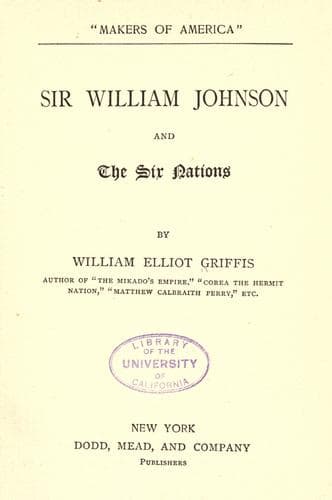
Sir William Johnson and the Six NationsGriffis, William Elliot
History
Sir William Johnson and the Six Nations
Griffis, William Elliot
Johnson, William, 1715-1774; United States -- History -- French and Indian War, 1754-1763
The settlers soon found that, in this as in previous wars, the French
and Canadian Indians were the more aggressive party, while the military
authorities of New York relied on a defensive policy. The governor,
George Clinton,—not the ancestor of the Clintons in the United States,
but the sixth son of the Earl of Lincoln,—had arrived in September,
1743. He was an old sea-dog, an ex-admiral, who knew as much about civil
government as one of his powder-monkeys on shipboard. It seemed to be
the policy of the British Government to send over decayed functionaries
and politicians who were favourites at court, but in every way unfitted
for the great problems of state in the complex community whose borders
were on Canada, where French power was intrenched. Too many of these
nominees of the Crown considered it to be their first duty to build up
their private fortune. Nevertheless, it was Clinton—who had probably
been influenced by his fellow-sailor, Captain Warren—who summoned
William Johnson, the trader, into public life.
Despite the superiority of the British fleet, the French moved more
quickly, and were first in America with reinforcements. The open
water-way from Canada into the heart of New York was the military nerve
of the continent. It made the Hudson and Mohawk Valleys the objective
point of the French invaders. The war, though not yet declared, was to
last five years, and, as we shall see, developed all the inherent
energies of Johnson, the young Irishman, who had already shown powers of
leadership. The military policy of the French was to keep the English
frontier in a state of ceaseless alarm, by small parties of stealthy
savages striking their blows unexpectedly all along the line from Oswego
to Hoosic. The story of the numberless petty raids is well told in
Drake’s “Particular History;” but in some cases the details are now
extant only in written accounts found in the Johnson papers, in church
records, in family Bibles, and on tombstones in Mohawk Valley and in New
England.
Johnson soon found himself where the Robinson Crusoe of poetry wished to
be,—“in the midst of alarms;” but his temper rose into the heights of
unshakable calm as the dangers increased. Invited, with his wife and
three infant children, to come and live in Albany till the war was over,
he declined, and remained at Mount Johnson, losing no opportunity to
win, to keep, and to increase his influence over the Iroquois. His
abilities and power were, as we have seen, brought to the notice of the
new governor, indirectly through his uncle, but immediately through the
introduction of Chief Justice De Lancey, a brother of his uncle’s wife.
In the month of April, 1745, William Johnson received a commission as
one of the justices of the peace in the county of Albany, which then
extended from Coeymans to Herkimer.
Public-domain text, read in full here on John Shaqi.
Reviews
Reviews
No reviews yet
Be the first to share your thoughts on this work.
Join the Discussion
Join the discussion
Sign in to leave a comment or review.
Sign InorCreate an account