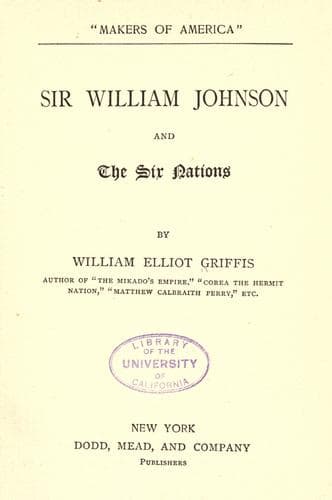
Sir William Johnson and the Six NationsGriffis, William Elliot
History
Sir William Johnson and the Six Nations
Griffis, William Elliot
Johnson, William, 1715-1774; United States -- History -- French and Indian War, 1754-1763
At this point the strictly private life of Johnson ended, and his
political career began. The situation of Mount Johnson was within easy
reach of all important places in the province which were likely to be
the seat of war. An easy day’s ride on horseback would bring him to
Albany, whence, by either land or water, the country was opened
northward to Crown Point, or southward to New York. Thence, over a cross
route by way of Saratoga Springs, a strong man well mounted could, by
hard riding, reach Mount Johnson from the foot of Lake George in a day
and part of a night. Westward also, by river or land route, there was
easy access to all the tribes of the Long House and to all the Mohawk
Valley settlements.
Johnson’s uncle, Captain Warren, had by the capture of a privateer
distinguished himself at sea, and receiving promotion to the grade of
Commodore, was ordered to command the naval forces for the reduction of
Louisburg. By his energy and ability strict blockade was maintained
while the American citizen soldiery under Pepperell tightened the coils
of investment. When the “Vigilante,” a French frigate laden with
reinforcements in men and provisions, had been decoyed and captured, the
fortress was surrendered. Warren became an admiral; and Pepperell, a
merchant like Johnson, was made a baronet,—the former one day, the
latter one month, after receipt of the news in England.
Chronology was in this case a key to English jealousy of the colonists,
whose growing strength and republicanism monarchical Britain feared. The
joy of the Americans was excessive. It culminated in Boston, where
“Louisburg Square” still preserves the name. The gladness on this side
of the Atlantic equalled the astonishment, flavoured with jealousy,
which fell upon Europe. One would have thought that it would salt
wholesomely the inborn contempt which the regular officers of the king’s
troops felt toward provincial fighters, but it did not; and Braddock,
Loudon, Abercrombie, and their foolish imitators were yet numerously to
come. Indeed, this success of provincial Americans induced a jealousy
that was to rankle for a generation or more in British breasts, to the
serious disadvantage of both Great Britain and the colonies, as we shall
soon see.
Public-domain text, read in full here on John Shaqi.
Reviews
Reviews
No reviews yet
Be the first to share your thoughts on this work.
Join the Discussion
Join the discussion
Sign in to leave a comment or review.
Sign InorCreate an account