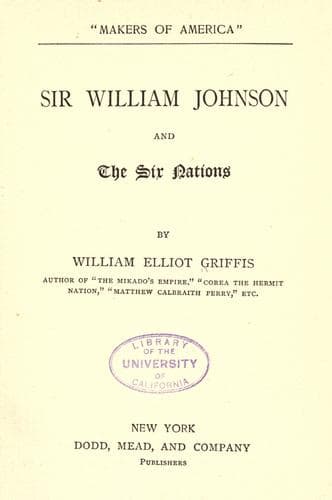
Sir William Johnson and the Six NationsGriffis, William Elliot
History
Sir William Johnson and the Six Nations
Griffis, William Elliot
Johnson, William, 1715-1774; United States -- History -- French and Indian War, 1754-1763
PREFACE vii
CHRONOLOGICAL OUTLINE xi
I. THE FIRST SETTLERS OF THE MOHAWK VALLEY 1
II. JOHNSON AS AN INDIAN TRADER 11
III. THE SIX NATIONS AND THE LONG HOUSE 35
IV. THE STRUGGLE FOR A CONTINENT 61
V. A CHAPTER IN THE STORY OF LIBERTY 80
VI. A TYPICAL FRONTIER FIGHT WITH INDIANS 92
VII. AT THE ANCIENT PLACE OF TREATIES 109
VIII. THE BATTLE OF LAKE GEORGE 132
IX. BRITISH FAILURES PREPARING FOR AMERICAN 146
INDEPENDENCE
X. THE “HEAVEN-BORN GENERAL” 167
XI. DECLINE OF THE INDIAN AS A POLITICAL FACTOR 178
XII. LIFE AT JOHNSON HALL 194
XIII. JOHNSON’S FAMILY; LAST DAYS; EUTHANASIA 206
INDEX 223
CHAPTER I.
THE FIRST SETTLERS OF THE MOHAWK VALLEY.
THE MOHAWK VALLEY was first settled by men escaping from feudalism. The
manor-system, a surviving relic of the old days of lordship and
villeinage, had long cursed England, Germany, and Holland, though first
outgrown and thrown off in the latter country. It was from this system,
almost as much as from Church laws, that the Pilgrim Fathers were glad
to escape and find free labour as well as liberty of conscience in
Holland,—the land where they “heard,” and found by experience, “that
all men were free.”
The Netherlands was the political training-school of the Pilgrims, and
of most of the leaders of the Puritans, who before 1640 settled New
England. In America they were more fortunate than their more southern
neighbours, in that they were freed from the semi-feudalism of the Dutch
Patroons and the manor-lords of Maryland and Virginia. The Hollanders,
on coming to New Netherland and settling under the Patroons, enjoyed far
less liberty than when in their own country. They were practically under
a new sort of feudalism unknown in their “Patria.” Their Teutonic
instincts and love of freedom soon, however, drove them to relinquish
their temporary advantages as manor-tenants, and to purchase land from
the Indians and settle in the “Woestina,” or wilderness. These Dutch
farmers cheerfully braved the dangers and inconveniences of “the bush,”
in order to hold land in fee simple and be their own masters.
Public-domain text, read in full here on John Shaqi.
Reviews
Reviews
No reviews yet
Be the first to share your thoughts on this work.
Join the Discussion
Join the discussion
Sign in to leave a comment or review.
Sign InorCreate an account