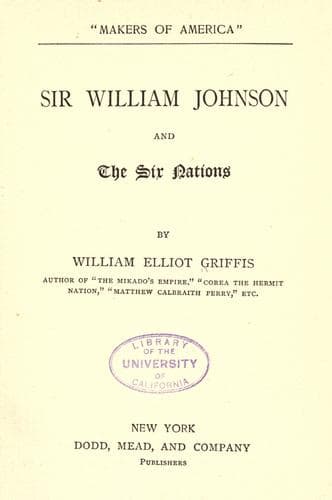
Sir William Johnson and the Six NationsGriffis, William Elliot
History
Sir William Johnson and the Six Nations
Griffis, William Elliot
Johnson, William, 1715-1774; United States -- History -- French and Indian War, 1754-1763
It was this spirit of independence that led a little company of worthy
sons or grandsons of men who had fought under William the Silent, to
settle in the “Great Flat,” or Mohawk Valley. They were led by Arendt
Van Curler, who, though first-cousin of the absentee Patroon Van
Rensselaer, of Rensselaerwyck, had educated himself out of the silken
meshes of semi-feudalism. Finding men like-minded with himself, who
believed that the patroon or manor-system was a bad reversion in
political evolution, he led out the Dutch freemen, and founded the city
of Schenectady. On the land made sacred to the Mohawks for centuries, by
reason of council-fires and immemorial graves, this free settlement
began. Here, not indeed for the first time in New Netherlands, and yet
at a period when the proceeding was a novelty, the settlers held land in
fee simple, and demanded the rights of trade.
It was before 1660 that these men, who would rather have gone back to
Patria, or Holland, than become semi-serfs under a manor-lord, came to
Van Curler, or “Brother Corlaer” as the Iroquois called him, and asked
him to lead them westward. In Fort Orange, July 21, 1661, in due legal
form, by purchase from and satisfaction to the Mohawk Indian chiefs, the
Indian title was extinguished. Thus, by a procedure as honourable and
generous as William Penn’s agreement with the Lenni Lenapes under the
great elm at Shackamaxon, was signalized the entrance of Germanic
civilization in the Mohawk Valley.
Early in the spring of 1662 Van Curler led his fourteen freemen and
their families into their new possession. Travelling westward, up what
is now Clinton Avenue in Albany, until they reached Norman’s Kill, they
struck northward, following the Indian trail of blazed trees, until
after a circuit of twenty miles they reached their future home, on a low
plateau on the banks of the Mohawk. On this old site of an Indian
village they began the erection of their houses, mill, church, and
palisades. The aboriginal name of the village, from which the Mohawks
had removed, pointed to the vast piles of driftwood deposited on the
river-flats after the spring floods; but not till after the English
conquest did any one apply the old Indian name of the site of
Albany—that is, “Schenectady”—to Van Curler’s new settlement. Both
French and Indians called the village “Corlaer,” even as they also
called the Mohawk River “the river of Corlaer,” and the sheet of water
in which he was drowned, not after its discoverer, Champlain, but
“Corlaer’s Lake.” Nevertheless, since the Mohawks had already retired
from the Hudson River, and “the place outside the door of the Long
House” was no longer Albany, but “Corlaer,” they and the Europeans, soon
after 1664, began to speak of the new settlement as “Schenectady;”
especially, as by their farther retirement up the valley, “Corlaer” was
now the true “Schenectady;” that is, outside the door of the Iroquois
confederacy or Long House. Schenectady enjoys the honour of being more
Public-domain text, read in full here on John Shaqi.
Reviews
Reviews
No reviews yet
Be the first to share your thoughts on this work.
Join the Discussion
Join the discussion
Sign in to leave a comment or review.
Sign InorCreate an account