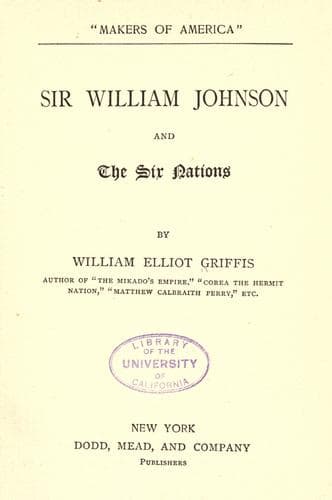
Sir William Johnson and the Six NationsGriffis, William Elliot
History
Sir William Johnson and the Six Nations
Griffis, William Elliot
Johnson, William, 1715-1774; United States -- History -- French and Indian War, 1754-1763
The title which the Mohawks gave their new white chief and leader in
1746, was, according to the anarchic and unscientific spelling of the
time, War-ragh-i-yah-gey. The term may be translated “Chief Director of
Affairs.” It may with economy of vocables be spelled Wa-ra-i-ya-gé.
Other matters contributed to this success, and utilized the work of
others. Conrad Weiser, the Pennsylvanian German interpreter, had been
recently among the tribes as far as Ohio, influencing them in favour of
the English. A happy accident—the coming of a delegation of Chickasaws
from the West and South to invade Canada, and to invite the Senecas to
take part and pilot them—awoke this most western division of the
Iroquois Confederacy to the importance of the accession. The
simultaneous offers of alliance and aid by other scattered tribes led to
a complete change of views. In a word, the Senecas resolved to sit at
the Albany caucus. With the tribes at each end, the west and the east of
the Long House, thus in substantial accord, Johnson directed the Mohawks
to send out runners to the whole confederation. Thus the work of winning
over the other few tribes, at least so far as attendance at Albany was
concerned, proved to be comparatively easy.
Even the feuds and quarrels which at the time divided the Long House
seemed to work for Johnson’s fame and the English cause. For some reason
in Iroquois politics, occult to a white man, the house was divided
against itself: the Senecas, Onondagas, and Mohawks composed one great
faction; the Oneidas, Cayugas, and Tuscaroras formed the other and
weaker. The latter tribe from the Carolinas, which had joined the
Confederacy a generation before, in 1712, were far from being won over
so as to take up arms for the English. When the fighting braves and
counselling old men came to pow-wow with the large faction, the first
thing done by them was to give the Mohawks, especially, a vigorous
scolding for having acted so presumptuously and independently without
taking council of the whole Confederacy. After lively debate and
rejoinder, it was agreed by all to go to Albany, but with the river
between the factions on their journey. So, along the banks of the Mohawk
the delegates of the Confederacy marched as far as Schenectady, when
quitting the river, the trail across country and to Norman’s Kill was
followed. All but three of the Mohawk chiefs had been won to the English
side. Of these, two of the Bear-totem clan lived at the upper castle at
Canajoharie, and the third of the Tortoise-totem clan at the lower
castle on the hill near Schoharie Creek. These dignitaries were finally
persuaded by Rev. Mr. Barclay, then living among the Mohawks, and the
famous Dr. Cadwallader Colden, who knew the Indians well, and later
became the historian of the Six Nations.
Public-domain text, read in full here on John Shaqi.
Reviews
Reviews
No reviews yet
Be the first to share your thoughts on this work.
Join the Discussion
Join the discussion
Sign in to leave a comment or review.
Sign InorCreate an account