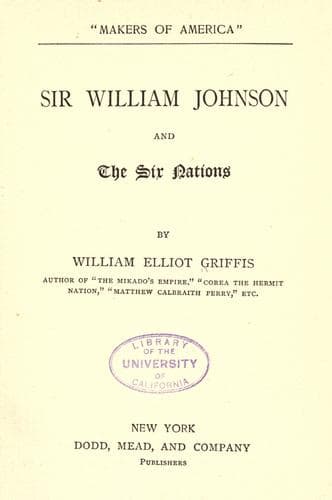
Sir William Johnson and the Six NationsGriffis, William Elliot
History
Sir William Johnson and the Six Nations
Griffis, William Elliot
Johnson, William, 1715-1774; United States -- History -- French and Indian War, 1754-1763
As might be expected, this bill was not allowed even a second reading,
but a motion was at once passed “that it was the great essential and
undoubted right of the representatives of the people of this colony to
begin all bills from raising and disbursing of money,” and that the bill
of the Council should be rejected. In an address to the governor it was
intimated that the one thousand pounds recently voted for entertaining
the Indians at the council at Albany had been used for other purposes
than the public good. After four days of foolish resistance, the
governor, knowing he was unable to make headway when so clearly in the
wrong, passed all the bills. Then, gratifying a personal spite at the
expense of the public, he dissolved the Assembly.
All this was what those who think the story of American liberty was
fought out chiefly in New England would call the “teapot-tempest
politics of the New York Assembly.” Yet here was the great principle
upon which republican government is founded, and for which Holland
revolted against Spain, and the American colonies against England; “our
great example,” as Franklin declared, being the Dutch republic.
The Dutch had, centuries before, beyond the dikes of Holland, developed
and fought for the doctrine of “no taxation without consent;” and
Clinton, Colden, and their coadjutors were clearly in the wrong.
Further, the representatives were right in hinting that Clinton and his
flatterers were too anxious to improve their own fortunes, and to make
the people pay for their needless junketings enjoyed in the name of
public service. Those who read the local history of the Hudson and
Mohawk Valleys know how burdensome to the people was the silly and
costly pageantry of royal governors on their travels.
Johnson, probably with his eyes needfully opened, on reaching his home
after the dissolution of the Assembly, found the outlook for the
ultimate occupation of the mid-continent by the English rather gloomy.
The French held the frontier of New York on its three strategic
lines,—Crown Point, La Presentation, and Niagara. They were now
planning to plant a mission, which should mean a fort and a church, at
Onondaga Lake, near which had perhaps been—if we so interpret the
inscription on the Pompey stone—a Spanish settlement once destroyed by
the Senecas. Even if the stone, inscribed with the symbols and
chronology of Christendom, were that of a captive, it is a mournful but
interesting relic.
Public-domain text, read in full here on John Shaqi.
Reviews
Reviews
No reviews yet
Be the first to share your thoughts on this work.
Elsewhere in the archive
Join the Discussion
Join the discussion
Sign in to leave a comment or review.
Sign InorCreate an account