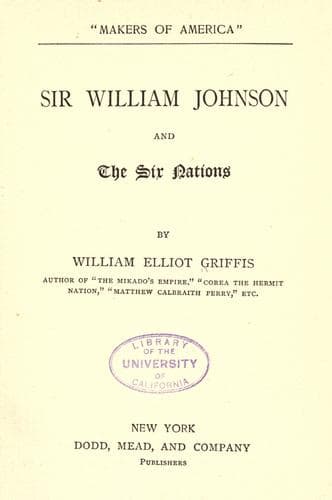
Sir William Johnson and the Six NationsGriffis, William Elliot
History
Sir William Johnson and the Six Nations
Griffis, William Elliot
Johnson, William, 1715-1774; United States -- History -- French and Indian War, 1754-1763
When Johnson heard the news, the Jesuits had already succeeded in
winning the consent of the chiefs even at this ancient hearth of the
Iroquois Confederacy. Such a move must be checkmated at once. Despite
the raw and inclement weather of late autumn, and his desire for rest
and reading, Johnson determined on a journey with its attendant
exposure. He set out at once for Onondaga. Summoning the chief men, he
asked them, as a proof of their many professions of friendship, to give
and deed to him the land and water around Onondaga Lake, to the extent
of two miles in every direction from the shores, for which he promised a
handsome present. Unable to resist their friend, the sachems signed the
deed made out by Johnson, who handed over money amounting to three
hundred and fifty pounds, and left for home. Writing to Governor
Clinton, he offered the land to the Government of New York at the price
he had paid. Thus were the designs of the French again foiled.
With the country at peace, and himself released from the responsibility
of Indian affairs, Johnson began to indulge himself more and more in
literary pursuits, the development of the Mohawk Valley, the moral and
intellectual improvement of the Indians, and the social advantage of the
white settlers. He had already a pretty large collection of books from
London in his mansion, but he sent an order, August 20, 1752, to a
London stationer for the “Gentlemen’s Magazine,” the “Monthly Review,”
the latest pamphlets, and “the newspapers regularly, and stitched up.”
He persuaded many of the Mohawks to send their children to the school at
Stockbridge, Mass., founded by John Sergeant in 1741, and served after
his death by America’s greatest intellect, Jonathan Edwards. His uncle,
the admiral, had already given seven hundred pounds to the support of
this school. Johnson’s correspondence was with the Hon. Joseph Dwight,
once Speaker of the Massachusetts House of Representatives, who had
married Mr. Sergeant’s widow, and was deeply interested in Indian
education.
In 1753 Rev. Gideon Hawley, who had taught the children of the Mohawks,
Oneidas, and Tuscaroras at Stockbridge, was sent from Boston to
establish a mission school on the Susquehanna River, west of Albany.
Visiting Mount Johnson, the young missionary was received by the host in
person at the gate. He spent a night enjoying the hospitality, and left
with Johnson’s hearty godspeed. Hawley was able to pursue his work
quietly until the breaking out of the war in 1756. After serving as
chaplain to Col. Richard Gridley’s regiment, he spent from 1757 to 1807,
nearly a half-century of his long and useful life, among the Indians at
Mashpee, Mass.
Public-domain text, read in full here on John Shaqi.
Reviews
Reviews
No reviews yet
Be the first to share your thoughts on this work.
Elsewhere in the archive
Join the Discussion
Join the discussion
Sign in to leave a comment or review.
Sign InorCreate an account