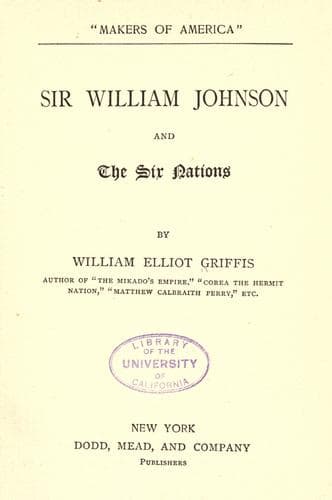
Sir William Johnson and the Six NationsGriffis, William Elliot
History
Sir William Johnson and the Six Nations
Griffis, William Elliot
Johnson, William, 1715-1774; United States -- History -- French and Indian War, 1754-1763
Johnson was also in warm sympathy with the efforts of Dr. Eleazar
Wheelock, who since 1743, when he began with Samson Occum, a Mohegan
Indian, had been steadily instructing Indian youths at Lebanon, Conn.
“Moor’s Indian Charity School,” as then called, was set upon a good
financial basis when in 1776 Occum and Rev. Nathaniel Whitten crossed
the ocean, and in England obtained an endowment of ten thousand pounds;
William Legge, Earl of Dartmouth, being president of the Board of
Trustees. At this school, among the twenty or more Indian boys, Joseph
Brant, sent by Johnson, was educated under Dr. Wheelock. Later the
Wheelock school was transferred to Hanover, N. H., and named after Lord
Dartmouth. On the college seal only, the Indian lads are still seen
coming up to this school instead of attending Hampton in Virginia, or
Carlisle in Pennsylvania. However, ancient history and tradition, after
long abeyance, were revived when, in 1887, a full-blooded Sioux Indian,
Dr. Charles Alexander Eastman, was graduated from Dartmouth’s classic
halls.
Various other attempts were made by Johnson, especially during the last
decade of his life, to interest the British authorities in Church and
State in the spiritual improvement of the Indians. The evidences of his
good intentions and generous purposes are seen in his correspondence.
Interesting as they are, however, they bore little fruit, owing to the
outbreak of the Revolution which divided both the red and the white
tribes. The baronet built a church for the Canajoharie Indians, and
supported religious teachers for a while at his own expense. In 1767,
being a man above his sect, he would have had the Indian school, which
grew into Dartmouth College, removed, and established in the Mohawk
Valley. Sectarian influence and ecclesiastical jealousies at Albany
prevented his plan from being carried out. The Valley was thus without a
college, until Union, founded and endowed almost entirely by the
Dutchmen of Schenectady, was established in 1786, free from sectarian
control, as its name implies. Under Eliphalet Nott’s presidency of
sixty-two years, its fame became national, and within its walls have
been educated some of the most useful members of the aboriginal race
called, by accident, Indians.
Admiral Warren died in Dublin, July 29, 1752, of fever; and Johnson
received the news shortly before setting out to attend the Executive
Council in New York, which met in October.
Public-domain text, read in full here on John Shaqi.
Reviews
Reviews
No reviews yet
Be the first to share your thoughts on this work.
Elsewhere in the archive
Join the Discussion
Join the discussion
Sign in to leave a comment or review.
Sign InorCreate an account