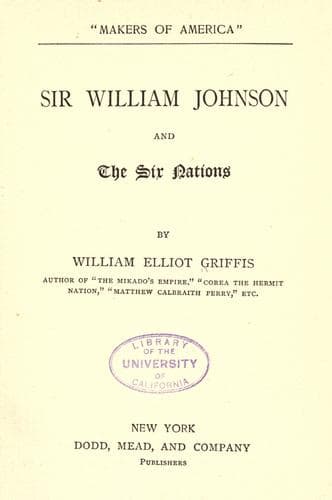
Sir William Johnson and the Six NationsGriffis, William Elliot
History
Sir William Johnson and the Six Nations
Griffis, William Elliot
Johnson, William, 1715-1774; United States -- History -- French and Indian War, 1754-1763
Fortunately for the Commonwealth, Governor Clinton had taken other
advice than that so liberally furnished in the past by the particular
member so obnoxious to the Assembly; and his opening message was
commendably brief, being merely a salutation, which was as briefly and
courteously returned. Now that the Tory firebrand was “out of politics”
for a while, peace once more reigned. An era of good feeling set in, and
harmony was the rule until Clinton’s administration ended. A new Board
of Indian Commissioners was chosen, by a compromise between the governor
and his little parliament. Plans for paying the colonial debt, for
strengthening the frontier, and for establishing a college were all
carried out.
Oswego was the watch-house on the frontier. In the early spring of 1753
the advance guard of a French army left Montreal to take possession of
the Ohio Valley. Descried alike by Iroquois hunters at the rapids of the
St. Lawrence and by the officers at Oswego, the news was communicated to
Johnson by foot-runners with wampum and by horseback-riders with
letters. Thirty canoes with five hundred Indians under Marin were
leading the six thousand Frenchmen determined to hold the domain from
Ontario to the Gulf of Mexico.
Whether troubled the more by the encroachments of the warlike French, or
by the English land-speculators and enterprising farmers who were now
clearing forests and settling on their old hunting-grounds, the Indians
could scarcely tell. Dissatisfied at having lost officially their friend
Johnson, disliking the commissioners, seeing what they considered as
their property, the Ohio, invaded by the French, while the New York
Government seemed to be inert or asleep, they sent a delegation to lay
their complaints before the governor and Council in New York. There they
roundly abused the whole government, and threatened to break the
covenant chain. As matter of fact, the trouble concerning land patents
arose out of transactions settled before Clinton’s time, which could not
at once be remedied in curt Indian fashion. All legal land alienations
in New York were, after the custom originating in Holland, and thence
borrowed by the American colonists and made a national procedure in all
the United States, duly registered; and into these examination must be
made. Both house and governor, however, agreed in choosing Johnson as
the man for the critical hour, and requested him to meet the tribes at
the ancient council-fire at Onondaga. Johnson, hearing that the Iroquois
had broken faith and again attacked the Catawbas in the Carolinas,
hastened matters by summoning one tribe, the Mohawks, to meet him at his
own home.
Public-domain text, read in full here on John Shaqi.
Reviews
Reviews
No reviews yet
Be the first to share your thoughts on this work.
Elsewhere in the archive
Join the Discussion
Join the discussion
Sign in to leave a comment or review.
Sign InorCreate an account