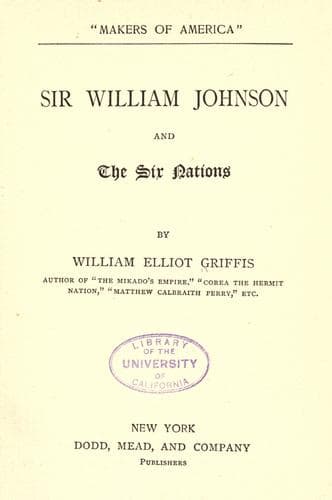
Sir William Johnson and the Six NationsGriffis, William Elliot
History
Sir William Johnson and the Six Nations
Griffis, William Elliot
Johnson, William, 1715-1774; United States -- History -- French and Indian War, 1754-1763
Again the stone house by the Mohawk became the seat of an Indian
council, and was enveloped in clouds of tobacco smoke. Johnson,
compelling them to drink the cup mingled with upbraiding and kindness,
while bountifully filling their stomachs from his larder, sent them away
in good humour, and most of them burning with loyalty. Besides thus
manifesting his singular power over the Mohawk savages, he met the
representatives of the United Confederacy at Onondaga, September 9. The
result of the ceremonies, the eloquence, the smoke, and the eating was
that the confederates, though sorely puzzled to know what to do between
the French and the English, promised loyalty to the brethren of Corlaer.
They would, however, say nothing satisfactory concerning the Catawbas,
some of whose scalps, and living members reserved for torture, even then
adorned their villages.
Governor Clinton had grown weary of the constant battle which he was,
probably with the stolid ignorance of many men of his time and class,
fighting against the increasing power of popular liberty. He saw it was
vain to resist the spirit which the Dutch, Scots, and French Huguenots
had brought into New York with them, or inherited from their sires, and
he longed for a rest and a sinecure post in England. He liked neither
the New York people nor the climate. When therefore his successor, Sir
Danvers Osborne, arrived on Sunday, October 7, Clinton hailed the day as
one of the happiest of his life. He shortly after sailed for home, to
spend the remainder of his years in a post for which he was better
fitted,—the governorship of Greenwich Hospital. He died in 1761,
fourteen years before the breaking out of the war which his own actions
had strongly tended to precipitate. His son, Sir Henry, led the British
regulars and mercenaries who were bluffed in North Carolina, driven off
at Fort Moultrie, and finally won victory at Long Island. He failed to
relieve Burgoyne, fought the drawn battle at Monmouth, captured
Charleston, dickered with Arnold, left Cornwallis in the lurch, and
returning baffled to England, shed much ink in defending himself against
his critics. Another family of Clintons shed high lustre on the American
name and the Empire State. One added another river parallel to the
Mohawk, flowing past Johnson’s old home, and joining the waters of the
Great Lakes to those of the Hudson and the Atlantic, making the city of
New York the metropolis of the continent.
Public-domain text, read in full here on John Shaqi.
Reviews
Reviews
No reviews yet
Be the first to share your thoughts on this work.
Elsewhere in the archive
Join the Discussion
Join the discussion
Sign in to leave a comment or review.
Sign InorCreate an account