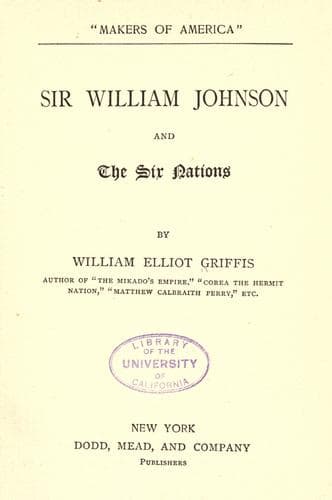
Sir William Johnson and the Six NationsGriffis, William Elliot
History
Sir William Johnson and the Six Nations
Griffis, William Elliot
Johnson, William, 1715-1774; United States -- History -- French and Indian War, 1754-1763
Sir Danvers Osborne’s career in America was a short tragedy in three
acts. It lasted five days. He came to be ground as powder between the
upper millstone of royal prerogative and the nether disk of popular
rights. He came from an aristocratic and monarchical country, whose
government believed that it was the source of power to the people, to
colonists whose fathers had been educated mostly under a republic, where
it was taught that the people were, under God, the originators of power.
Charged with instructions much more stringent than those given to his
predecessor, he was confronted in the town-hall by the city corporation,
whose spokesman’s opening sentence was that “they would not brook any
infringement of their liberties, civil or religious.” On meeting his
Council for the first time, he was informed that any attempt to enforce
the strict orders given him and to insist upon an indefinite support,
would be permanently resisted. That night the unfortunate servant of the
king took his own life. He committed suicide by hanging himself on his
own garden wall.
De Lancey, the chief-justice, was now called to the difficult post of
governor, and to the personally delicate task of serving King George and
his former associates, whom he had so diligently prodded against
Clinton, Colden, and Johnson. This was especially difficult, when the
Assembly found, in the instructions to Sir Danvers Osborne, how
diligently the late governor and his advisers had slandered and
misrepresented them to the British Government. The good results of a
change in the executive were, however, at once visible, and the Assembly
promptly voted money for the defence of the frontier, for the governor’s
salary, for his arrears of pay as chief-justice, for Indian presents,
for his voyage to Albany, and indeed, for everything reasonable. They
added a complaint against Clinton, and a defence of their conduct to the
Crown and Lords of Trade, which De Lancey sent to London.
The clouds of war which had gathered in the Ohio Valley now broke, and
M. Contrecœur occupied Fort Du Quesne. George Washington began his
career on the soil of the State of Pennsylvania, in which his longest
marches, deepest humiliations, fiercest battles, and most lasting civil
triumphs were won; and on the 4th of July, 1754, honourably surrendered
Fort Necessity. The French drum-beat was now heard from Quebec to
Louisiana. The English were banished behind the Alleghanies, and their
flag from the Ohio Valley.
Public-domain text, read in full here on John Shaqi.
Reviews
Reviews
No reviews yet
Be the first to share your thoughts on this work.
Elsewhere in the archive
Join the Discussion
Join the discussion
Sign in to leave a comment or review.
Sign InorCreate an account