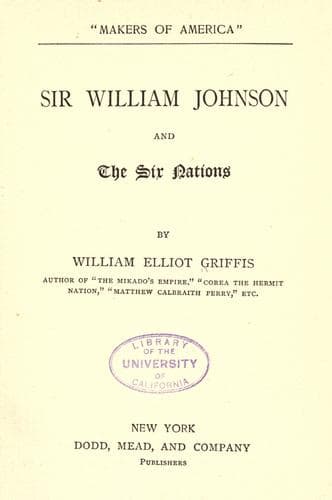
Sir William Johnson and the Six NationsGriffis, William Elliot
History
Sir William Johnson and the Six Nations
Griffis, William Elliot
Johnson, William, 1715-1774; United States -- History -- French and Indian War, 1754-1763
It was now vitally necessary that the colonies should form a closer
union for defence against French aggression and the inroads of hostile
savages. The Iroquois tribes had been able to unite themselves in a
stable form of federalism. Why could not the thirteen colonies become
confederate, and act with unity of purpose? Besides so great an example
on the soil before them, there was the New England Confederation of
1643, which had been made chiefly by men trained in a federal republic.
Both the Plymouth men and many of the leaders of New England had lived
in the United States of Holland, and under the red, white, and blue
flag. There they had seen in actual operation what strength is derived
from union. _Concordia res parvæ crescunt_ (“By concord little things
become grand”), was the motto of the Union of Utrecht, familiar to all;
but in New York the republican motto _Een-dracht maakt Macht_ (“Union
makes strength”) needed no translation, for its language was the daily
speech of a majority of the people.
It seemed now, at least, eminently proper that the Congress of Colonies
should be in the state settled first by people from a republic, and at
Albany, the ancient place of treaties, and at the spot in English
America where red and white delegates from the north, east, west, and
south can even now assemble without climbing or tunnelling the
Appalachian chain of mountains.
By direction of the Lords of Trade, the governments of all the colonies
were invited to meet at Albany, so that a solemn treaty could be at one
time made with all the Indian tribes, by all the colonies, in the name
of the king.
For treaty-making with the Iroquois, the most powerful of all the Indian
tribes, there was only one place,—Albany. Dinwiddie, of Virginia,
vainly wanted it at Winchester, Va., while Shirley, of Massachusetts,
jealous of New York, and a genuine politician, wished to keep himself
before the voters, and to come after the elections were over. His party
was more than his province or the country. As the Indians had already,
according to orders from England, been notified, the New York Assembly
declined to postpone time or place.
In Albany the streets were cleaned and repaired by order of the City
Council, and the delegates were given a public dinner at the municipal
expense. The Congress met in the City Hall on the 19th of June, 1754,
twenty-five delegates from nine colonies being present; and whether in
personal or in representative dignity formed the most august assembly
which up to this time had ever been held in the Western World. The
colonies were named in the minutes according to their situation from
north to south. All were represented, except New Jersey, the Carolinas,
and Georgia.
Public-domain text, read in full here on John Shaqi.
Reviews
Reviews
No reviews yet
Be the first to share your thoughts on this work.
Elsewhere in the archive
Join the Discussion
Join the discussion
Sign in to leave a comment or review.
Sign InorCreate an account