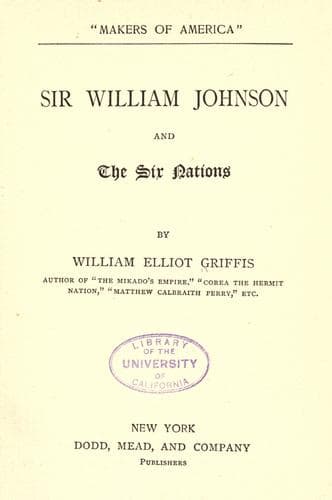
Sir William Johnson and the Six NationsGriffis, William Elliot
History
Sir William Johnson and the Six Nations
Griffis, William Elliot
Johnson, William, 1715-1774; United States -- History -- French and Indian War, 1754-1763
The business proper began when Johnson read a paper, which was the
official report of the Board of Commissioners on Indian Affairs, in
which the political situation was exposed. In it propositions were made
to build forts in the Onondaga and Seneca countries, with a missionary
in each place; to forbid the sale of rum, and to expel and keep the
Frenchmen out of the Indian castles. The speech, prepared as the voice
of the Congress, was delivered June 28 to the Indians who were present,
and who had to be urged by the governor to attend. After various
conferences and much speech-making on either side, including an address
by Abraham, a scorching philippic by King Hendrick,—both Mohawk sachems
and brothers,—and the distribution of gifts, the Indians went home
apparently satisfied. To the edification of delegates from some of the
colonies, where Indians were deemed incapable of understanding truth and
honour, they found that Governor De Lancey and Colonel Johnson treated
them as honest men who understood the nature of covenants. Whereas the
laws of Joshua and Moses had been elsewhere applied only too freely to
Indian politics by the elect of Jehovah, the New York authorities really
believed that the Ten Commandments and the Golden Rule had a place in
Indian politics.
Other questions of vital interest to the colonies were discussed. On the
fifth day of the session of the Congress, while waiting for the Indians
to assemble, a motion was made and carried unanimously that “a union of
all the colonies” was absolutely necessary for their security and
defence. A committee of six was appointed to prepare plans of union, and
from the ninth day until the end of the session this important matter
was under debate. On the 9th of July the Congress voted “That there be a
union of his Majesty’s several governments on the continent, so that
their councils, treasure, and strength may be employed in due proportion
against their common enemy.” On the 10th of July the plan was adopted,
and ordered to be sent to London for the royal consideration.
Public-domain text, read in full here on John Shaqi.
Reviews
Reviews
No reviews yet
Be the first to share your thoughts on this work.
Elsewhere in the archive
Join the Discussion
Join the discussion
Sign in to leave a comment or review.
Sign InorCreate an account