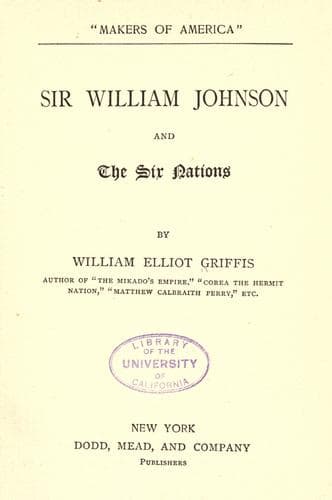
Sir William Johnson and the Six NationsGriffis, William Elliot
History
Sir William Johnson and the Six Nations
Griffis, William Elliot
Johnson, William, 1715-1774; United States -- History -- French and Indian War, 1754-1763
How far this Albany plan of union, which looked to a Great Council of
forty-eight members meeting at Philadelphia under a President-general,
resembled or foreshadowed the National Constitution of 1787, we need not
here discuss. Certain it is, that though the exact plan proposed was
rejected, both by the colonies and by Great Britain, the spirit of the
movement lived on. Between the year 1754 and that of 1776 was only the
space of the life of a young man. Between the “Congress”—the word in
this sense was a new coinage, dating from the meeting of colonial
delegates in Albany, after the burning of Schenectady in 1690—in the
State House at Albany and the one in Carpenter’s Hall in Philadelphia,
the time was even less. Certain it is that the assembly of
representatives of the colonies at Albany in 1690 was the first occasion
of the popular use of the word “Congress” as now used, and usually
written with a capital, while that in 1748 made it a word of general
acceptance in the English language. Before that time and meeting it had
other significations not so august; but while these have fallen away,
the other and chief signification in English remains. Further, from this
time forth the “Continental”—that is, the American as distinct from the
British, the independent as discriminated from the transatlantic—idea
grew. In common speech, the continental man was he who was more and more
interested in what all the colonies did in union, and less in what the
king’s ministers were pleased to dictate. More and more after the Albany
Congress Wycliffe’s idea prevailed,—that even King George’s “dominion
was founded in grace” and not on prerogative. More and more the legend
on the coins, “Georgius Rex Dei Gratia,” faded into the nature of a
fairy tale, while the idea grew that the governments derive their
authority from the consent of the governed. To those wedded to the idea
that religion can live only when buttressed by politics, that a church
owes its life to the state, this increase of democratic doctrines was
horrible heresy, portending frightful immorality and floods of vice. A
State without a King, a Church without politically appointed rulers and
the support of public taxation, a coin without the divine name stamped
on it, were, in the eyes of the servants of monarchy, as so many
expressions of atheism. Not so thought the one member of the Albany
Congress who lived to sign the Declaration of Independence and the
National Constitution of 1787,—Benjamin Franklin, who incarnated the
state founded politically by Penn; nor the Quaker, Stephen Hopkins, of
Rhode Island, who lived to put his sign-manual to Jefferson’s immortal
document, July 4, 1776.
CHAPTER VIII.
THE BATTLE OF LAKE GEORGE.
Public-domain text, read in full here on John Shaqi.
Reviews
Reviews
No reviews yet
Be the first to share your thoughts on this work.
Elsewhere in the archive
Join the Discussion
Join the discussion
Sign in to leave a comment or review.
Sign InorCreate an account