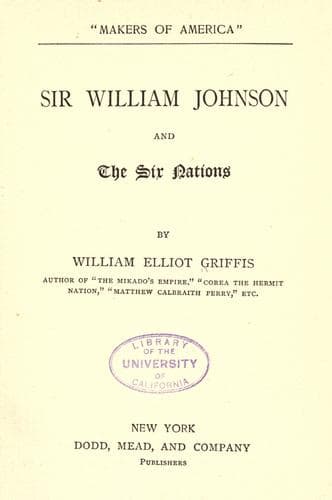
Sir William Johnson and the Six NationsGriffis, William Elliot
History
Sir William Johnson and the Six Nations
Griffis, William Elliot
Johnson, William, 1715-1774; United States -- History -- French and Indian War, 1754-1763
As for Shirley and Johnson, they seemed always unable to work
harmoniously together, the latter resenting what he believed to be the
needless interference of the other. Shirley found Johnson more than a
match for him in the rather acrid correspondence conducted in New York
during January. Living but a few rods apart, the liveried coloured
servants of these colonial dignitaries kept their soles warm in carrying
despatches. In jealousy of each other, the two gentlemen were as
incompatible as Siamese twins, their only common ligament being loyalty
to the Crown. Johnson was determined to get and hold his commission from
the Crown, and not be subject to colonial governors or assemblies. He
laid the whole matter before the Lords of Trade, and aided by his
friends at Court, secured a flattering verdict in his favour. In July,
1756, there came to him from his Majesty’s Secretary, Fox, a commission
as Colonel, Agent, and sole Superintendent of all the affairs of the Six
Nations, and other Northern Indians, with an annual salary of six
hundred pounds. By orders from the same august source, the Northern
colonies were prohibited from transacting business with the Indians, so
that the whole matter was settled in Johnson’s hands.
Being now well intrenched in his office and authority, Johnson, with his
usual versatility and vigour, turned from the duties of the desk and
council-room to the activities of the field. The frontiers of New
Hampshire had been harassed during the winter by prowling bands of
savages, but the French now attempted a more ambitious raid. Warned by
Indian runners, who had made the first part of their journey on
snow-shoes from Fort Bull at the Oneida “carry,” he at once sent
ammunition to the garrison of thirty men. On skates from Montreal to
Fort Presentation, and thence on snow-shoes to the Oneida portage, the
party of nearly three hundred Frenchmen, after ten days of gliding and
stepping, appeared before the wooden fort, March 27. Their demand for
surrender was met by a volley, which in return was answered by a charge,
a crushing in of the gate, and a massacre of all but five of the
garrison. Among the military stores destroyed were two tons of powder.
About the same time the ship-carpenters at Oswego became the prey of
raiding Indians from Niagara, who returned with three prisoners and
twelve scalps. Forays were made by Canadian savages, even into Ulster
and Orange Counties, within a day’s horse-ride of New York.
The winter was unusually mild, which caused the utter abandonment of
Shirley’s expedition to Crown Point; while the numerous petty successes
of the French and Indians turned the faces of the vacillating members of
the Iroquois cantons toward Canada as the winning side.
Public-domain text, read in full here on John Shaqi.
Reviews
Reviews
No reviews yet
Be the first to share your thoughts on this work.
Elsewhere in the archive
Join the Discussion
Join the discussion
Sign in to leave a comment or review.
Sign InorCreate an account