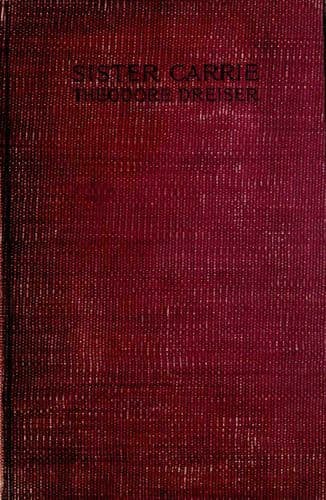
Chicago (Ill.) -- Fiction; Didactic fiction; Mistresses -- Fiction; New York (N.Y.) -- Fiction; Young women -- Fiction
The true meaning of money yet remains to be popularly explained and
comprehended. When each individual realises for himself that this thing
primarily stands for and should only be accepted as a moral due--that it
should be paid out as honestly stored energy, and not as a usurped
privilege--many of our social, religious, and political troubles will
have permanently passed. As for Carrie, her understanding of the moral
significance of money was the popular understanding, nothing more. The
old definition: "Money: something everybody else has and I must get,"
would have expressed her understanding of it thoroughly. Some of it she
now held in her hand--two soft, green ten-dollar bills--and she felt
that she was immensely better off for the having of them. It was
something that was power in itself. One of her order of mind would have
been content to be cast away upon a desert island with a bundle of
money, and only the long strain of starvation would have taught her that
in some cases it could have no value. Even then she would have had no
conception of the relative value of the thing; her one thought would,
undoubtedly, have concerned the pity of having so much power and the
inability to use it.
The poor girl thrilled as she walked away from Drouet. She felt ashamed
in part because she had been weak enough to take it, but her need was so
dire, she was still glad. Now she would have a nice new jacket! Now she
would buy a nice pair of pretty button shoes. She would get stockings,
too, and a skirt, and, and--until already, as in the matter of her
prospective salary, she had got beyond, in her desires, twice the
purchasing power of her bills.
She conceived a true estimate of Drouet. To her, and indeed to all the
world, he was a nice, good-hearted man. There was nothing evil in the
fellow. He gave her the money out of a good heart--out of a realisation
of her want. He would not have given the same amount to a poor young
man, but we must not forget that a poor young man could not, in the
nature of things, have appealed to him like a poor young girl.
Femininity affected his feelings. He was the creature of an inborn
desire. Yet no beggar could have caught his eye and said, "My God,
mister, I'm starving," but he would gladly have handed out what was
considered the proper portion to give beggars and thought no more about
it. There would have been no speculation, no philosophising. He had no
mental process in him worthy the dignity of either of those terms. In
his good clothes and fine health, he was a merry, unthinking moth of the
lamp. Deprived of his position, and struck by a few of the involved and
baffling forces which sometimes play upon man, he would have been as
helpless as Carrie--as helpless, as non-understanding, as pitiable, if
you will, as she.
Public-domain text, read in full here on John Shaqi.
Reviews
Reviews
No reviews yet
Be the first to share your thoughts on this work.
Join the Discussion
Join the discussion
Sign in to leave a comment or review.
Sign InorCreate an account