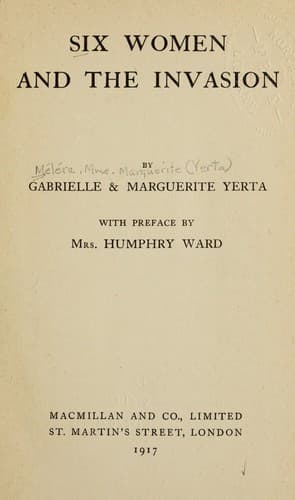
Six Women and the InvasionMéléra, Marguerite-Yerta
History
Six Women and the Invasion
Méléra, Marguerite-Yerta
World War, 1914-1918 -- Personal narratives
their jackets had lost their sleeves, the girls' frocks were in rags.
Their distress melted the people of the village to tears. Jouville has
but four hundred inhabitants, and if their religious and political
passions are lively, their hearts are none the less warm.
Jouville-East-Hill and Jouville-West-Hill showed themselves equally kind
to the emigrants, and not only kind, but forbearing, and the emigrants
needed forbearance. They were not the _élite_, and they were guilty of
many a misdeed. M. Charvet well-nigh died of anger the day he discovered
that his beloved fish-pond had been secretly rid of its finest
inhabitants.
Another farmer was breathless with rage when he saw the potatoes he had
planted the day before dug up in the morning.
Ah, you rascally emigrants! Of course some people will feel deeply
shocked at such behaviour, and deem it a hanging matter--for instance,
well-fed people, secure from danger, who afar off scowl at the Germans,
the emigrants, and the typhus-smitten people with the very same
feelings.
But I who was once numbered with those emigrants, who like them was a
prey to hunger, I could not find the smallest stone to throw at them.
And the inhabitants of Jouville, who were the witnesses of our life,
threw no stone either. None of them caused our chains to be drawn
tighter by complaining to the Germans. For the invaders of the north of
France are very severe to the people who transgress the eighth
commandment ... "Thou shalt not steal."
The Jouvillians did even better. From all quarters they brought to us
and to the school-mistress of the village quantities of clothes fit to
wear, if not new, and these were distributed among the raggedest
refugees. We ourselves, with two others, did our best to clothe the
orphan girls, and the poor things were extremely proud of their new
frocks made up of shreds and patches. Some one gave them wooden shoes,
and the bruised little feet could patter down the stony high-road
without fear. The emigrants soon looked upon us as their private
property, and thought us good for everything. An old woman would come to
us, for instance, with an imperious air:
"I have been told that you are visitors of the poor, and then ..." some
request followed.
The unfortunate visitors of the poor would sometimes have been glad to
live on charity themselves. Well, this reminds me that we did once
receive alms. We were following a path by the river, bordered with
pleasant houses. It was a day of perquisitions, and the soldiers,
having turned everything upside down, had left the quarter which we
were traversing. A good old woman was coming from the river-side with a
loaf in her hand, and the mere sight of the white, light crumb made our
mouths water. The woman stopped, and said with a sidelong glance:
"You see, they don't want to know I have a little flour left. I hid my
loaf in the hole of a willow tree."
She burst out laughing, and we chimed in.
Public-domain text, read in full here on John Shaqi.
Reviews
Reviews
No reviews yet
Be the first to share your thoughts on this work.
Elsewhere in the archive
Join the Discussion
Join the discussion
Sign in to leave a comment or review.
Sign InorCreate an account