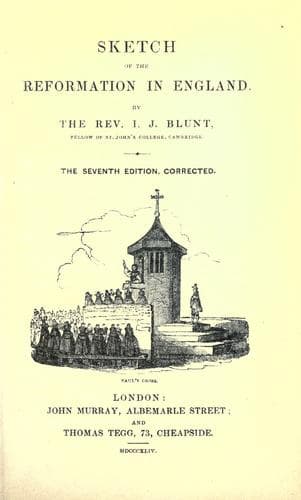
Sketch of the Reformation in EnglandBlunt, John J. (John James)
History
Sketch of the Reformation in England
Blunt, John J. (John James)
Great Britain -- Church history; Reformation -- England
after the dissolution, “there is no vicar at all, but the farmer is
vicar and parson altogether; and only an old castaway monk or friar,
which can scarcely say his matins, is hired for twenty or thirty
shillings, meat and drink; yea, in some places, for meat and drink
alone, without any wages. I know,” he continues, “and not I alone,
but twenty thousand men know, more than five hundred vicarages and
parsonages thus well and gospelly served after the new gospel of
England.”[254] And so crying was this evil, for even great parishes
and market towns were utterly destitute of the word of God,[255]
that there was nothing for it but to ordain the lowest mechanics to
these worthless benefices, no man of education being willing to accept
such a pittance, for the endowments, it must be observed, had been
seized precisely at the time when the wages of superstition in the
shape of fees, which before the Reformation supplied no small part
of the vicar’s income, were extinguished also, and holy toys were
no longer vendible. The cause of religion, however, being found at
length to suffer seriously, both from the ignorance and the lives
of these preachers, Archbishop Parker enjoined his suffragrans to
refuse such candidates holy orders, and then pluralities became a
bad, but it was the best, or rather the only, alternative.[256] Queen
Anne lamented and endeavoured to remedy the evil. She discharged all
livings under fifty pounds a year, according to an improved valuation
which she directed the bishops and others to make, from the payment
of tenths to the exchequer, a tax which had caused many benefices to
remain altogether without incumbents; and by another and still more
munificent act, she made over the first-fruits and tenths of such as
were undischarged, to the augmentation of small livings; a fund which,
it may be here observed, had been seized by Henry, the successor of
the pope in his fees as he was in his supremacy; hereby doing what in
her lay to heal the laceration which the system of lay-impropriations
had inflicted on the church, and purchasing for herself, beyond most
other sovereigns that have sat upon the throne of England, a good
renown. But, in general, this ill-gotten and ill-applied wealth served
only to verify the adage, “that the devil’s corn goes all to bran.”
The receivers of the plunder rarely prospered; and it is observed
by Sir. H. Spelman, about the year 1616, that on comparing the
mansion-houses of twenty-four families of gentlemen in Norfolk, with
as many monasteries, all standing together at the dissolution, and all
lying within a ring of twelve miles the semi-diameter, he found the
former still possessed by the lineal descendants of their original
occupants in every instance; whilst the latter, with two exceptions
only, had flung out their owners again and again some six times over,
none less than three, through sale, through default of issue, and very
often through great and grievous disasters.[257] Nor was this the
Public-domain text, read in full here on John Shaqi.
Reviews
Reviews
No reviews yet
Be the first to share your thoughts on this work.
Elsewhere in the archive
Join the Discussion
Join the discussion
Sign in to leave a comment or review.
Sign InorCreate an account