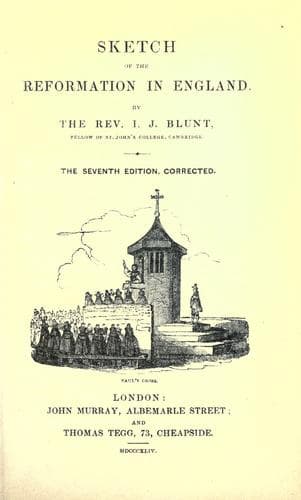
Sketch of the Reformation in EnglandBlunt, John J. (John James)
History
Sketch of the Reformation in England
Blunt, John J. (John James)
Great Britain -- Church history; Reformation -- England
designed to meet perhaps more effectually; and it is not uninteresting
to remark, how the great wants of nature still make themselves known,
whatever convulsions a nation may undergo, and still conduct it to
something like the same course as before, though not, perhaps, under
the same name; and when the flood subsides that has covered the earth,
to see how Ararat rears his head as he did at the first, and Pihon
returns into his wonted channel to water the garden. Well would it be
for the peace of the world if this consideration had its due influence
that should paralyse, but that should moderate; if men would not
subject society to needless confusion, whilst they attempt to expel
nature by a fork, sure as it is to recoil and recover itself; if they
would spare themselves and others the inconvenience of a struggle,
where they fight as one beating the air.
The convulsion felt throughout the country on this memorable occasion
was probably more violent than any which it has experienced either
before or since. The joints of society were thoroughly loosed; a vast
proportion of the population was turned adrift upon the wide world,
their employment gone, their relief gone too. Seventy-two thousand
persons are said to have perished by the hand of the executioner in the
reign of King Henry, some made desperate by want, and some made bold
by the lawless license of the times. Cromwell, who was the the King’s
political adviser throughout this great measure, felt the state rocking
under him, and suggested the sale of the abbey lands and tithes at
easy prices to the nobles and gentry, that by this means the leading
persons in every county might be pledged to support the new order of
things, and be tied by the tooth. Thus popish lands, as it was said,
made protestant landlords, and thus the _lay impropriator_, a
character hitherto almost or altogether unknown, took his beginning.
How far the country was a gainer by the exchange of ecclesiastical
for other landlords may be questioned. The monks were accused of
covetousness; yet it is singular that no legal provision for the
poor was wanted so long as the property was in their hands, and that
it had scarcely left their hands before it was found necessary to
make such a provision; the statute of the 5th of Elizabeth being the
first direct one of the kind.[252] The monks were said to deal very
thriftily with the incumbents of their livings; yet it is remarkable
that no law for preventing the dilapidation of parsonages was called
for till the 13th of the same reign. The monks lavished decorations
upon their own chapels to the comparative neglect of their country
churches, but they never pulled down all the houses on an estate in
order that there might be no congregation, and then converted the
church into a straw barn, because there was none.[253] The monks
gave a miserable stipend to their vicar, “but now,” says one Henry
Brinklow, in a curious address to the members of both houses shortly
Public-domain text, read in full here on John Shaqi.
Reviews
Reviews
No reviews yet
Be the first to share your thoughts on this work.
Elsewhere in the archive
Join the Discussion
Join the discussion
Sign in to leave a comment or review.
Sign InorCreate an account