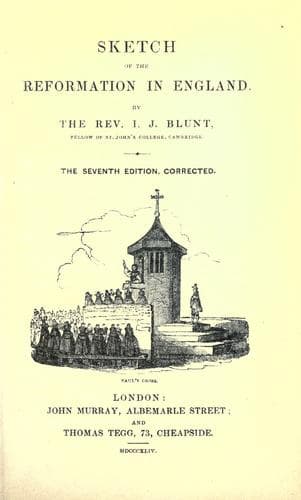
Sketch of the Reformation in EnglandBlunt, John J. (John James)
History
Sketch of the Reformation in England
Blunt, John J. (John James)
Great Britain -- Church history; Reformation -- England
opinion of an individual, or of a visionary; on the contrary, it was
very generally entertained by men the most sober-minded. Archbishop
Whitgift, in his appeal to Queen Elizabeth against the sacrilegious
designs of the Earl of Leicester and others, challenges this as a truth
“already become visible in many families, that church land, added to
an ancient and just inheritance, hath proved like a moth fretting a
garment, and secretly consumed both.”[258] Lord Burleigh, whose bias
was rather that of the Puritan than of the Roman Catholic, cautioned
Thomas, his first-born, not to build on an impropriation, as fearing
the foundation might hereafter fail.[259] “I charge you,” was one of
the three injunctions laid upon his son by Lord Strafford when under
sentence of death, “touching church property, never to meddle with
it; for the curse of God will follow all them that meddle with such a
thing that tends to the destruction of the most apostolical church upon
earth.”[260] And even Selden (no violent advocate of ecclesiastical
dues) censures the alienation of tithes. “And let them remember,” he
writes, “who says, ‘It is a destruction for a man to devour what is
consecrated.’”[261] Indeed, during the latter half of the seventeenth
century--whether from compunction--whether from the attention of the
public having been directed to the subject by Archbishop Laud, and by
popular treatises which made their appearance about that time--whether
from the experience and notoriety of the evil, and the consequent
shame it drew upon its abettors, or from whatever other cause--many
impropriations were voluntarily relinquished, and a very considerable
number of vicarages were more or less augmented.[262] Still there is
no abuse out of which Providence cannot extract some good. This act
of desecration (as it was considered) proved the safety, perhaps, of
the yet tottering Protestant cause, under the reign of Queen Mary; for
the great proprietors had violent scruples against returning to a form
of faith which might entail upon them the surrender of their lands.
And though it is probable that the religious establishment of this
country, if it had stood at all, would have stood upon firmer ground
at this moment, had the Reformation been completed (for it was left
sadly imperfect), by the revision instead of the excessive alienation
of the revenues of the church; yet, as affairs turned out, that very
spoliation, perhaps, sustained the Church of England a second time,
when the Puritan lay impropriators threw themselves in the way (whether
consistently or not) of the abolition of tithes;[263] and more unlikely
things have happened than that it should do the country the like good
office again; for it would require a man of more intrepidity than even
the disingenuous Neal (who walks over this incident more delicately
than is his custom where there is room for a fling at the church) to
draw a distinction between the lay and ecclesiastical tithe-holder, in
Public-domain text, read in full here on John Shaqi.
Reviews
Reviews
No reviews yet
Be the first to share your thoughts on this work.
Elsewhere in the archive
Join the Discussion
Join the discussion
Sign in to leave a comment or review.
Sign InorCreate an account