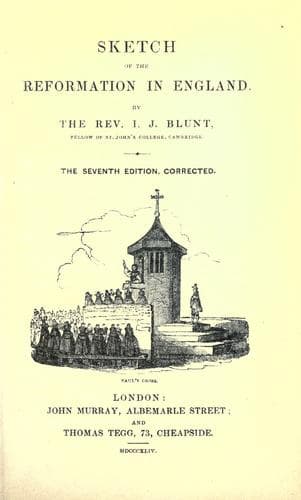
Sketch of the Reformation in EnglandBlunt, John J. (John James)
History
Sketch of the Reformation in England
Blunt, John J. (John James)
Great Britain -- Church history; Reformation -- England
favour of the former; and to maintain that the right of the one is
inviolable, because he does not observe the conditions upon which it
was originally founded; whilst that of the other is nugatory, because
he does. Certain it is, that the people were at first very reluctant to
transfer the payment of tithes (which they had ever regarded, and which
the law had ever taught them to regard, as inseparably connected with
religious services,) to laymen;[264] and however it may be the fashion
of our own times to spare the impropriator, and assail the clergymen,
nothing is more true, than that it was not so from the beginning; but,
on the contrary, that it was then thought no less an anomaly to pay
tenths to the landlord, than it would now be thought so to pay fees for
burials and baptisms to the squire. But it must be confessed that the
Roman Catholic Church, owing to that entire selfsecurity from which she
did not rouse herself till the Philistines were upon her, had in some
measure to thank herself for the irreverence with which ecclesiastical
property was now treated. Not twelve years before the great overthrow
of the monasteries, the pope himself granted Wolsey a bull for the
dissolution of several religious houses,[265] and the application of
the funds to the erection and endowment of his colleges at Oxford and
Ipswich; and, indeed, generally, by the diversion of estates from one
ecclesiastical use to another, a process perpetually going on, often
effected rather for individual advantage than for the public good, and
often under circumstances of collusion and contrivance discreditable
to all the parties concerned, a feeling of respect for the possessions
of the church as exclusive and inalienable was weakened. The tendency
of such a traffic (however confined to a privileged order) was to
make the article itself looked upon in the light of merchandise, and
to invite towards it the itching palms of the profane. And even,
now amongst other advantages not, to be sure, unalloyed, which the
law against simony in some degree secures--such as the less frequent
purchase of livings at high prices, for which interest of money would
be sought by an exaction of dues to the uttermost farthing, to the sure
destruction of the pastoral character--such as the better chance hereby
offered to meritorious men without influence, of finding a patron when
the temptation he would be otherwise under to sell rather than give,
is partly taken out of his way;--besides these advantages there is
another, and not the least, in the skreen which it interposes between
the church, and the market, and the total confusion which it prevents
between the things of men and the things of God.
Public-domain text, read in full here on John Shaqi.
Reviews
Reviews
No reviews yet
Be the first to share your thoughts on this work.
Elsewhere in the archive
Join the Discussion
Join the discussion
Sign in to leave a comment or review.
Sign InorCreate an account