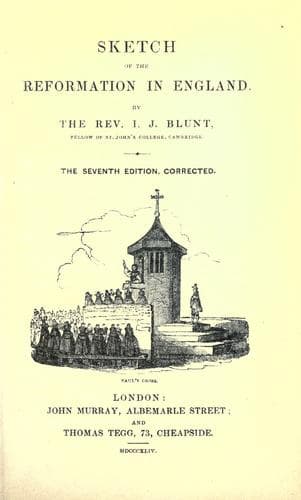
Sketch of the Reformation in EnglandBlunt, John J. (John James)
History
Sketch of the Reformation in England
Blunt, John J. (John James)
Great Britain -- Church history; Reformation -- England
Henry proved himself an apt scholar in the lessons which the
incautious, not to say unlawful, practice of the church of Rome taught
him. And so successfully had he overcome all primitive notions of the
honour due to sacred things, that even before the dissolution, he seems
to have converted many monasteries into stables; a scandal of which
honest Latimer did not fail to remind him publicly; conceiving it a
monstrous thing; that “abbeys, which were ordained for the comfort of
the poor,” should be kept for the king’s horses; nor convinced of the
contrary by the nobleman (who seems to have been ripe to become an
impropriator, as very likely he did) who said to him, “What hast thou
to do with the king’s horses?--horses be the maintenance and part of
a king’s honour and also of his realm; wherefore, in speaking against
them, ye are speaking against the king’s honour.”[266]
Cranmer was not (as may be well believed) an unconcerned spectator of
this great revolution in the possessions of the church; but though he
agreed with Cromwell in the desire of the dissolution, he differed from
him with regard to the application of the proceeds. Indeed, the views
they respectively took of the nature of ecclesiastical property do not
appear to have coincided. The one was rather acting in a political,
the other in a religious spirit. Cromwell was concerned to right the
monarchy, Cranmer to save a church. The former was for the suppression
of the religious houses, because the supremacy of the crown could not
be otherwise secured; the latter had this for his object too, but
still more the annihilation of the abuses of purgatory, masses for the
dead, saint-worship, and pilgrimage, of all which the abbeys were the
incorrigible patrons. So far, therefore, they went hand in hand. But in
the disposal of the vast fund which accrued from the confiscation of
the church estates, Cranmer did not, like Cromwell and the parliament,
regard it as a matter for the king to take his pastime with, according
to his own mere will and motion.[267] Nor would he dissipate, nor did
he think it lawful to divert from its original destination, and that
the promotion of God’s glory, so ample a revenue, and make it over at
once, and for secular purposes only, to the crown. He, therefore, was
for considering it as still a sacred treasure, to be applied to sacred
ends; and out of the old and corrupted monasteries he was desirous
to see arise new and better foundations: houses attached to all the
cathedrals, to serve as nurseries for the clergy of the diocese in
religion and learning; an addition made to the incomes of the inferior
class;[268] and the number of sees increased, with a corresponding
diminution in their extent, that the bishop might be in deed as well
as in name the overseers.[269] To these wise and good propositions
Latimer added another, no less commendable, that a few of the greater
abbeys should be left for pious and charitable uses. For the priory
Public-domain text, read in full here on John Shaqi.
Reviews
Reviews
No reviews yet
Be the first to share your thoughts on this work.
Elsewhere in the archive
Join the Discussion
Join the discussion
Sign in to leave a comment or review.
Sign InorCreate an account