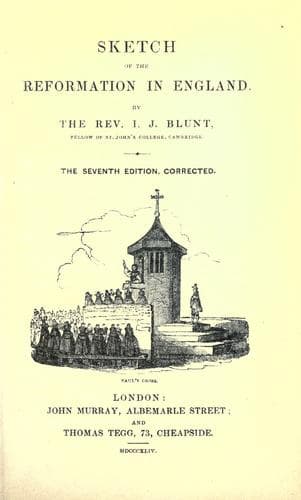
Sketch of the Reformation in EnglandBlunt, John J. (John James)
History
Sketch of the Reformation in England
Blunt, John J. (John James)
Great Britain -- Church history; Reformation -- England
of Malvern, above all, he intercedes with great earnestness, not that
it “should stand in monkery, but so as to be converted to preaching,
study, and prayer;” and then he adds, “Alas! my good Lord” (it is to
Cromwell that he makes his fruitless appeal), “shall we not see two
or three in every shire changed to such remedy?”[270] In suggesting
these and similar measures, the reformers felt that they had right on
their side. Whether the property of the church had not accumulated to
an amount inconvenient to the state, as unduly narrowing the limits
within which other professions were left to walk, may be doubted; and
therefore Cranmer, with his usual moderation, consented that the king
should resume the lands which the piety (or, as it would be now said,
the superstition,) of his ancestors had granted to ecclesiastics, and
dispose of them as seemed best to him. But they felt also, that church
endowments in general, and tithes in particular, were goods set apart
for the promotion of religion from time immemorial, the possessor of
a manor erecting upon it a church, and charging it for ever with the
maintenance of a man whose business it should be to teach the people
upon it the law of God, and thus acknowledging on his own part his
tenure to be under God, “the land His, and himself a stranger and
sojourner with Him.”[271] This was the origin of parishes; the parish
co-extensive (as it is still almost always found) with the manor, so
that even where the latter chances to have a part distant and detached,
the parish, however inconvenient it may be for pastoral superintendance
and instruction, usually claims it too. The fulfilment of the
conditions annexed to these grants, it was only equitable that the
donor and his heirs should exact and regulate; they were the natural
guardians of the charities; and when the lapse of years, the course of
events, and public convenience, had caused this guardianship to devolve
upon the state, the state, like any other guardian, had a right to
superintend the trust so as to carry into effect the designs of the
donor, but no right whatever to alienate it, apply it to purposes of
its own, and thereby frustrate those intentions. It had a right, for
instance, to provide the best religious instruction which was to be
had, even though it was such as the benefactor had not contemplated;
and to exclude such as was found, on a more intimate knowledge of the
subject, to be erroneous, even though it was such as the benefactor had
sanctioned; it being obvious that his intention was to guide, not to
mislead, those for whom he had shown so lively an interest; but it had
no right to withhold all religious instruction whatever, dispose of the
trust to the best bidder, and putting the produce in its pocket, say
that it was corban. If a professorship of astronomy had been founded
by some lover of the science when the system of Ptolemy was in the
ascendant, surely the trustees of his foundation would be thought to
Public-domain text, read in full here on John Shaqi.
Reviews
Reviews
No reviews yet
Be the first to share your thoughts on this work.
Elsewhere in the archive
Join the Discussion
Join the discussion
Sign in to leave a comment or review.
Sign InorCreate an account