Sketch of the Reformation in EnglandBlunt, John J. (John James)
History
Sketch of the Reformation in England
Blunt, John J. (John James)
Great Britain -- Church history; Reformation -- England
But though many of the reformers thus kept their opinions to
themselves, or only communicated them to their confidential companions,
and when the doors were shut; there were others of a more intrepid
spirit, who saved the commissioners the necessity of resorting to
force or fraud for their conviction by publicly contending for the
faith, and even carrying the war into the enemy’s borders. A martyr of
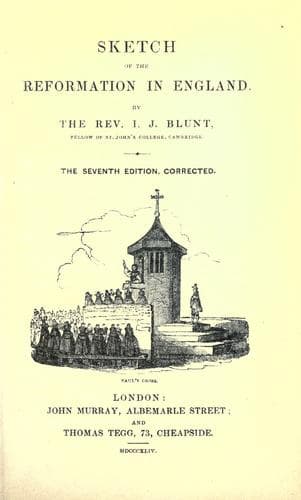
this kind was Dr. Barnes; he preached openly at Paul’s Cross, where
he upheld the doctrine of justification by faith only, (a tenet that
seems to have been almost as unpalatable to the Roman catholics as a
renunciation of transubstantiation itself,) and challenged Gardiner
to the controversy, against whom indeed this sermon was directed,
in reply to one which he had delivered from the same popular pulpit
shortly before. There is a passage in his discourse very expressive of
the rude style of preaching which in those days prevailed, and which
the friars in Italy, and probably elsewhere, have not yet entirely
abandoned. Barnes calls upon Stephen Gardiner by name to answer him;
alluding in “a pleasaunt allegory” (as John Fox expresses it--an
opinion to which the priests in Spanish America would still subscribe)
to a cock-fight, wherein he likens Gardiner to a fighting cock, and
himself to another, and reproaches his antagonist with lacking good
spurs, as being a _garden_-cock; then shifting his joke, he taxes him
with being a bad _gardener_, as having set evil herbs in the garden
of God’s Scriptures; and once more changing his weapon, he accuses
him of a want of logic and grammar-rules; alleging, in reference to
the act of the Six Articles, that if he had expressed himself in the
schools as he had done at the Cross, he would have given him six
stripes.[311] Latimer’s sermons, almost the only complete specimens
we have of the pulpit oratory of that time, are full of the same
familiar, not to say mean, images,--tales of Robin Hood, or of the
Godwin Sands, or of an execution at Oxford, or of the woman going to
church at St. Thomas of Acres, because she could not get a wink of
sleep in any other place--mixed up with puns the most idle and similes
the most unsavoury.[312] Two other sermons we have seen of the same
date, by one Thomas Lewer, a master of St John’s College, Cambridge,
preached the one at Paul’s Cross, the other before the king, and
both in the year 1550, and these are not much less conversational in
their tone than those of Latimer. The coarse material of hortatory
theology at the Reformation and before it, imparts its character in
a degree to our Homilies, which, however full of sound doctrine and
wholesome advice, would often not a little shock the sense of ears
polite, were they to be faithfully delivered in our churches. And
later still, Fuller tells us, in his History of the University of
Cambridge, of a country parson in his time who preached at St. Mary’s
on the words, “God hath _dealt_ to every one the measure of faith”
(Rom. xii.
Public-domain text, read in full here on John Shaqi.
Reviews
Reviews
No reviews yet
Be the first to share your thoughts on this work.
Elsewhere in the archive
Join the Discussion
Join the discussion
Sign in to leave a comment or review.
Sign InorCreate an account