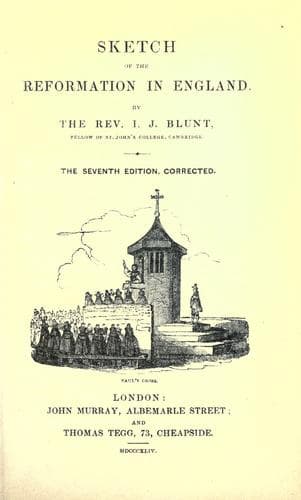
Sketch of the Reformation in EnglandBlunt, John J. (John James)
History
Sketch of the Reformation in England
Blunt, John J. (John James)
Great Britain -- Church history; Reformation -- England
In addition to the scanty means of instruction in a better faith
which were thus extorted from the king in his last years like drops
of blood, he was prevailed upon by Cranmer to issue orders for the
destruction of some favourite images, of which the superstitious
abuse was the most notorious[343]--those of our Lady of Walsingham,
our Lady of Ipswich, St. Thomas of Canterbury, and St. Ann of Buxton,
being the chief;[344] to sanction the introduction into the churches
of certain prayers or suffrages--the litany which we still use,
except that some objectionable clauses have been since omitted, being
of the number;[345] and to permit, moreover, the use of occasional
prayers, for the supply of temporary wants, or the removal of temporary
calamities--for rain or for fair weather--that thus the hearts of the
congregation might be enlisted in their devotions, and the lukewarmness
be counteracted, which was fast alienating them from public worship,
conducted, as it was, in a language of which they were ignorant,
though with errors of which they were aware.
Meanwhile, the same vigilant prelate supplied, as far as he had the
opportunity, the livings in his gift with men devoted to the cause
which he had at heart, and encouraged the more frequent delivery
of sermons; whereby, though much violent collision of doctrine was
produced amongst the preachers, still sparks of truth were elicited,
and light, though not without heat, was dispersed.[346]
Thus stood the Reformation, when Henry, who had now done all the work
which such an instrument was fit for, died, pressing in his last
moments the hand of Cranmer, to whom, and to whom only, through evil
report and through good report, he had ever been faithful and true. To
him he bequeathed a church which was little but a ruinous heap; its
revenues dissipated, its ministers divided, its doctrines unsettled,
its laws obsolete, impracticable, and unadapted to the great change it
had sustained.
It remains for us to trace the re-construction of these shattered
materials--to watch the wise master-builders as they pursued their
difficult task to its accomplishment; and beholding the pains, the
perseverance, the study, the time which it cost them, to distrust
the wild suggestions of an age of crude experiment and superficial
knowledge--an age which would rush in without knowing why, upon forms
and institutions which the sagest heads have grown gray in devising and
perfecting; and rather listen, as far as regards our church, to the
advice of the ancient, unpretending though it be--“Spartam nactus es,
hanc exorna.”
CHAPTER X.
EDWARD VI.--ADVANCE OF THE REFORMATION.--ERASMUS’S
PARAPHRASE.--HOMILIES.--CRANMER’S CATECHISM.--OFFICE OF
COMMUNION.--BOOK OF COMMON-PRAYER.--TIME OF SERVICE, AND
LENGTH.--PRIMER.--ARTICLES OF 1553.--MODERATION OF THE ENGLISH
REFORMERS.
Public-domain text, read in full here on John Shaqi.
Reviews
Reviews
No reviews yet
Be the first to share your thoughts on this work.
Elsewhere in the archive
Join the Discussion
Join the discussion
Sign in to leave a comment or review.
Sign InorCreate an account