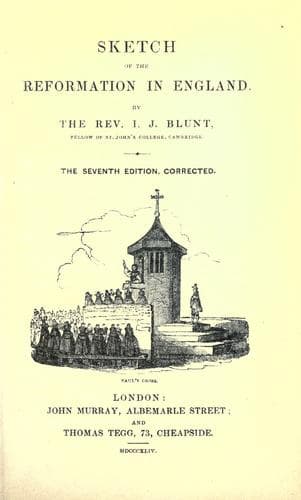
Sketch of the Reformation in EnglandBlunt, John J. (John James)
History
Sketch of the Reformation in England
Blunt, John J. (John James)
Great Britain -- Church history; Reformation -- England
The accession of Edward, the Josiah of his country, as he was commonly
called in his own day, reanimated the Reformation; and during his
short reign it was that the church of England was constructed, in
the main, such as we now see it. The young prince, who was brought
up a protestant, was himself eminently calculated to recommend the
cause. His own character, both mental and moral, was a most persuasive
advocate of the system which had nurtured it. Cardan, who was called
into England to prescribe for the Archbishop of St. Andrews, then sick
of a dropsy, and was introduced to the king, now in his fifteenth year,
relates the particulars of a short conversation which he had with him
on the subject of comets, which won the heart of the philosopher,
and, like a journal which has come down to us written in his own
hand,[347] certainly argues in him a wit beyond his age. Latin he
spoke, says Cardan, who seems to have conversed with him in it, as
readily as himself; and in many other languages he is said to have been
a proficient, stimulated, perhaps, by an apophthegm of Roger Ascham,
his sister’s schoolmaster, though not his own, “that as a bird cannot
soar unto heaven with one wing, so cannot a man attain unto excellence
with one tongue.” Indeed, to a study of tongues, we are told by a
correspondent of his own, he had more applied than to any matter either
of history or of policy, the holy Scriptures excepted; nevertheless,
the pains which were taken to render him in all things an accomplished
prince may be seen in the questions (eighty-four in number) submitted
to him by the clerk of the council, probably at the desire of the
Protector Somerset; and which were intended as food for his private
speculations and debates with his friends. They are such as embrace
nearly all those principles of government upon which he would be
afterwards called to act--“Whether is better for the commonwealth that
the power be in the nobility or the people?” “How easily a weak prince
with good order may long be maintained; and how soon a mighty prince
with little disorder may be destroyed?” “What causeth an inheritor
king to lose his realm?” “Whether religion, besides the honour of God,
be not also the greatest stay of civil order?” “How dangerous it is
to be the author of a new matter?”[348]--with many other problems,
well worth the attention of those to whom the education of a sovereign
is confided. His heart was as good as his head; and as it is with
the latter that we believe, but with the former that we believe unto
righteousness, so did its natural dictates rise in arms against those
more subtle principles according to which Cranmer had conscientiously
persuaded himself, and endeavoured to persuade the king, that the death
of Joan of Kent was a duty; and happy would it have been for the memory
of that otherwise almost unspotted character, had he submitted his
more mature but more sophisticated judgment to the righteous tears of
this gifted boy.
Public-domain text, read in full here on John Shaqi.
Reviews
Reviews
No reviews yet
Be the first to share your thoughts on this work.
Elsewhere in the archive
Join the Discussion
Join the discussion
Sign in to leave a comment or review.
Sign InorCreate an account